The depletion of the ozone layer and its effects on human health and ecosystems was the focus of the Environmental Effects Assessment Panel (EEAP) carried out within the framework of the 35th anniversary of the Protocol of Montréal.

This year, the EEAP was promoted by the Ozone Secretariat of the United Nations Environmental Program (UNEP), and was held from September 19 to 27 in Kalmar, Sweden. It featured a panel of experts, including the researcher from the University of Magallanes, attached to the Cape Horn International Center and the BASE Millennium Institute, Dr. Roy Mackenzie and, the postdoctoral researcher from the University of Magallanes and the Millennium Institute BASE, Dr. Brenda Riquelme del Río.

The Panel brought together professionals with extensive experience in the effects of ozone layer depletion on human health, ecosystems, atmospheric chemistry, ecology, materials engineering, among others. “We were asked to examine the UNEP-EEAP report that will be reviewed on the 35th anniversary of the Montreal Protocol and to participate in the discussion of the impact of this treaty on climate care and conservation of ecosystems and biodiversity,” said Roy Mackenzie.

Regarding the Montreal protocol, the researcher attached to the BASE Millennium Institute indicated that “it has been very effective in protecting the planet’s stratospheric ozone layer and preventing the global increase in UV-B solar radiation on the Earth’s surface. Consequently, this international treaty has prevented the large-scale detrimental effects of high UV-B radiation on agricultural productivity, terrestrial organisms, and ecosystems (…) Thanks to this treaty, the Antarctic ozone hole is expected to close around the 2070s.”

Affiliated researcher Millennium Institute BASE, Dr. Roy Mackenzie, and postdoctoral researcher Millennium Institute BASE, Dra. Brenda Riquelme.

For years, Roy Mackenzie and Brenda Riquelme have focused their efforts on sensorizing and monitoring the moss Polytrichum strictum (Polytrichaceae), conducting experiments in response to the manipulation of UV-A and UV-B light, both in the field and in the laboratory. They have developed a working method in Omora Park, on the north coast of Navarino Island, with the aim of establishing long-term monitoring of bryophytes as indicators of environmental variability in the subantarctic zone of Magallanes.

“Our results on the effect of UV radiation on subantarctic bryophytes will continue to contribute to the quadrennial reports generated by the EEAP-UNEP panel, taking part of a global database that will favor evidence-based decision-making for the countries that are  part of the Montreal treaty,” said Roy Mackenzie, also an ecologist at the BASE Millennium Institute.

For her part, Dr. Brenda Riquelme del Río expressed that “receiving the invitation to be part of the review of the report has been tremendously gratifying and challenging, we have taken it as a recognition for our contribution in the study of the effects of the ozone hole on plants from Puerto Williams, the southernmost city on the planet”.

You can learn more about the conference here.

By: Constanza Barrientos

Main photography: image retrieved from the Linnaeus University website in Sweden

The meeting held from September 21st to 23rd in the region of Magallanes and Chilean Antarctic, brought together principal and associate researchers from Millennium Biodiversity Institute of Antarctic and Sub-Antarctic Ecosystems (BASE) to review the progress and plan new projects.

Among the topics addressed at the first annual  BASE Millennium Institute meeting, were the  definition of cross-cutting study models, upcoming Antarctic expeditions, international collaboration and decentralization challenges. The meeting took place at Almasur Hotel in Punta Arenas. The SEREMI of Science of the Austral Macrozone, Verónica Vallejos, and the director of the Chilean Antarctic Institute (INACH) Marcelo Leppe participating in the event highlighted the opportunity to learn more about what BASE Millennium Institute proposes, mainly because it closely approximates the principles that the ministry has within this government: “It is a pleasure to see that there are young women researchers who are participating in the project,” Vallejos said.

Dr. Ellie Poulin, director of the BASE Millennium Institute stressed the importance of this milestone since it is the first time that the researchers of the BASE Millennium Institute gather off screen to finally establish a work plan -all together- and develop strategies to generate interdisciplinary and transdisciplinary collaboration, since the institute not only contemplates biology studies, but also conservation and Antarctic governance.

“We were indebted in many aspects of the studies -mainly in marine ecosystems- and with a strong approach in evolutionary biology, biodiversity and of course the component of time, which is Climate Change”, stressed Marcelo Leppe, director of INACH.

Finally, in terms of challenges, Dr. Julieta Orlando, alternate director of BASE Millennium Institute, pointed to knowledge management and team articulation: “to focus on certain models that allow us to work together, comprehensively, to make a real interdisciplinary, and transdisciplinary work, taking advantage of the experiences and expertise that each of the researchers have”.

The meeting ended by highlighting the link made with research centers such as the Institute of Ecology and Biodiversity (IEB), the Cape Horn International Center for Global Change Studies and Biocultural Conservation (CHIC), and the Research Center for Dynamics of High Latitudes Marine Ecosystems (IDEAL).

By: Constanza Barrientos and Nadia Politis

Audiovisual: Patricio Moreno, Triada Producciones

Translated by: Catalina Ovando
Under the motto “girls’ education is a climate solution”, researchers Valentina Bernal and Catalina Jara began their participation in Tremendas Foundation’s Climatic Academy. A project aimed at 12 to 25 year-old girls and adolescents from different countries in Latin America and the Caribbean.

A mentorship that seeks to guide young people on Climate Action projects linked to the Sustainable Development Goals (SDG) of the United Nations, is part of the objectives of the Climate Academy of Tremendas Foundation. The researchers from the BASE Millennium Institute, Valentina Bernal and Catalina Jara, participated in this online space from the cities of Santiago and Concepción.

Valentina Bernal is also a doctoral researcher at the University of Chile, and she highlighted the initiative which allowed her to work with participants from Mexico, Ecuador, Peru, and Chile: “It is the first time that I have mentored girls and adolescents, and to be able to approach young people was a super good experience. I am very grateful for the Tremendas Foundation and what they do. I saw that the girls were very concerned about the issues of Climate Change, gender equality and very motivated to make changes in society”, she pointed out.

While Catalina Jara, also a master’s researcher at the University of Concepción (UdeC), highlighted the opportunity as a relevant space for the exchange of vocational experiences: “It was very pleasant to be able to participate with Tremendas, when I was younger I did not have the opportunity to find a space where I could share concerns and talk about Climate Change. Being able to do it now as a mentor, with more training, is something super gratifying. I hope to sow a seed and motivate the girls to do more projects related to science”, she affirmed when describing her work with participants from El Salvador, Peru and Chile.

From left to right: BASE doctoral researcher, Valentina Bernal, and BASE master’s researcher, Catalina Jara.

In addition to the presence of the  Millennium Institute Biodiversity of Antarctic and Sub-Antarctic Ecosystems (BASE) at the Climatic Academy, the Director of Communications of BASE, Nadia Politis, joins as a mentor linked to the Science communication, Digital Communication and New Media. There will be three online cycles, carried out by the three mentors, which will take place every Saturday until September 10th. Subsequently, the meetings will end with the presentation of a project and/or prototype.

The Climatic Academy is a free program which includes a four-month training through online mentoring, and it seeks to support young women and girls in the development of practical projects that help them move “from banner to action”, generating a climate action community that connects scientific and academic knowledge with territorial needs.

By: Constanza Barrientos

The description of the new species identified as Subantarctic Rayadito (Aphrastura subantarctica), was published in the international scientific journal of Nature “Scientific Reports”, an article that presents the result of the research carried out over six years by researchers from the Cape Horn International Center for Studies of Global Change and Biocultural Conservation (CHIC), a baseline project funded by the National Research and Development Agency, ANID, which develops scientific studies with application for conservation in the Cape Horn Biosphere Reserve.

The team of researchers was led by the director of CHIC, an ecologist and academic from the University of Magallanes (UMAG) and the University of North Texas, Ricardo Rozzi, along with Claudio Quilodrán, Esteban Botero Delgadillo, Constanza Napolitano, Juan Carlos Torres Mura, Omar Barroso, Ramiro Daniel Crego, Camila Bravo, Silvina Ippi, Verónica Quirici, Roy Mackenzie, Cristián Suazo, Juan Rivero de Aguilar, Bernard Goffinet, Bart Kempenaers, Rodrigo Vásquez and Elie Poulin, the latter director of BASE Millennium Institute.

Many of them carried out their work in the area of the Diego Ramírez Islands archipelago, especially on Gonzalo Island, located south of Cape Horn, just over 800 kilometers south of Punta Arenas, sailing through the channels.

The subantarctic rayadito is distinguished from the species of thorn-tailed rayadito (Aphrastrura spinicauda) that inhabits the southern forests of Patagonia such as those distributed on Navarino Island, in Puerto Williams, where they nest in tree cavities. This new species nests on the surface in the middle of the grass and its morphological appearance is more robust with a weight of approximately 16 grams (in comparison to the 12 grams thorn-tailed rayadito ), with a larger bill, a longer tarsus and a shorter tail. Also, they move shorter distances from ground level and fly shorter distances. The habitat that the new species faces is extreme, with gusts of wind that normally exceed 100 kilometers per hour.

The area is of great interest for marine conservation and access for research has been provided by the Chilean Navy, in a research and sovereignty alliance that has been developed for more than 20 years in the area. There the researchers have developed successive campaigns being transported by Navy ships where the institution maintains the lighthouse that is inhabited by naval personnel.

rayadito subantártico
Rayadito subantártico (Aphrastura subantarctica) Imagen: O. Borroso y R. Mackenzie

The academic from the University of Magallanes and the University of North Texas, as well as director of  CHIC, Ricardo Rozzi, stressed that “this research has been like an obsession to understand how a bird, which lives in the habitat of forests, which has the habit of life of feeding on the trunks and branches, of nesting in trunk cavities, how does it come to live in this case in a place where there are no trees, no bushes and no woody species, literally in the middle of the ocean a forest bird has managed to survive.”

“The Diego Ramírez Islands are still very little known by Chilean society, and this small endemic bird will be a symbol or emblematic species that will contribute to the knowledge for the country’s culture. We will continue to develop knowledge, appreciation and protection of this archipelago with the scientific leadership of UMAG in a collaborative effort with the Regional Government of Magallanes, the Navy and other public institutions”, said Ricardo Rozzi.

The biologist of the University of Chile and linked to the CHIC, Rodrigo Vásquez, a specialist in birds, says that “now this species has been found, which was described in very basic literature, as belonging to the same Thorn-tailed rayadito, but thanks to a slightly deeper study, we were able to genetically see that it differs in a mutation from the rest of the species of the classic Rayadito, in addition to morphological and behavioral differences”.

There are some individuals with little genetic difference on Cape Horn Island. Its morphological features stand out, such as its larger legs, greater body weight and shorter tail, which does not seem to make it a great flier given the high winds in the Diego Ramírez Islands, where the vegetation is low and the nests are made at ground level as they detected it.

The researcher Constanza Napolitano, an academic from the Department of Biological Sciences and Biodiversity at the University of Los Lagos, in Osorno, recalls that she led part of the genetic analysis, while another part was addressed by Esteban Botero’s group. She highlights the collaborative work carried out between different researchers who contributed to reach these results, and the approach to the scientific question in an integrative way from different angles and complementary methodological approaches.

The University of Magallanes rector, José Maripani, highlighted this work and stated that “this shows the importance for the Region of Magallanes and Chilean Antarctica, and for our country and the world, that a new species of land bird is identified that inhabits further south of Cape Horn and at the same time how transcendent are the conservation initiatives such as the Diego Ramírez- Drake Passage Marine Park for the conservation of different species and where UMAG has worked on the proposal of the general administration plan of that marine park.

By: Cape Horn International Center, CHIC

Main photography: O. Borroso and R. Mackenzie

The 10th Open Science Conference of the Scientific Committee on Antarctic Research (SCAR) will be held until August 10th, and a research team from BASE Millennium Institute will present the results of their research on biodiversity and international polar law.

As an opportunity to exhibit work, research progress, network building and involvement in scientific activities of the Scientific Committee on Antarctic Research SCAR, the Open Science Conference began its tenth version with India as the host country.

The 10th SCAR Open Science Conference will be held from August 1st to August 10th, 2022 in an online mode, free and open to all. The conference is organized by the National Center for Polar and Ocean Research (NCPOR), an autonomous organization under the Ministry of Earth Sciences (MoES) of the Government of India.

From Chile, more than a dozen researchers from the Millennium Institute Biodiversity of Antarctic and Subantarctic Ecosystems (BASE) will present the results of their research on biodiversity, conservation and international polar legislation: “In times when climate change reminds us of the importance of promoting with greater strength of Antarctic science for the benefit of society, it is a duty for us to participate in the 10th SCAR Open Science Conference”, said Dr. Elie Poulin, director of BASE Millennium Institute. “Our young researchers will also show their progress in Antarctic research, a unique and enriching opportunity, which demonstrates the fertile and dynamic environment that we are fostering from the Southern Hemisphere and Chile in terms of human capital training in Antarctic issues,” he added.

In line with this year’s online version, the organizers invite you to share images and reflections with the hashtag #SCAR2022 on social networks and follow broadcasts on the SCAR YouTube channel. More information at www.scar2022.org

By: Constanza Barrientos and Nadia Politis

Within the framework of the 14th version of the International Congress on Fish Biology, ICBF (International Congress on the Biology of Fish), Dr. Luis Vargas-Chacoff, Dr. Elie Poulin and doctoral researcher Daniela Nualart, traveled to the city of Montpellier to publish studies on the physiology and evolution of Antarctic fish.

The researchers from BASE Millennium Institute participated in the 14th International Congress on the Biology of Fish in France with their studies on the physiology and evolution of the Antarctic and sub-Antarctic fish, Harpagifer antarcticus.  In the event, carried out in the city of Montpellier, from June 28th to July 1st, the relevance of the southern species for the food chain and the study of Climate Change was highlighted.

Dr. Luis Vargas-Chacoff, Researcher at the BASE Millennium Institute, Ideal Center, and academic at the Austral University of Chile, was part of the organizing committee of the congress, through the symposium on Ecology, Biology and Diversity of polar fish, where he presented Preliminary results of the study “Hypoxia and thermal effects on the osmoregulation of Antarctic fish Harpagifer antarcticus”. In addition, he presented researches related to the physiology of Atlantic salmon (Salmo salar) and coho salmon (Oncorhynchus kisutch), together with the doctoral researcher from the BASE Millennium Institute and the Austral University of Chile (UACh), Daniela Nualart.

At the same time, the Lead Researcher  and Director of BASE Millennium Institute, Dr. Elie Poulin, participated in the polar fish symposium with the exhibition “Phylogeography, population genetics and adaptation of the Harpagifer (Nototheniidae) throughout the Southern Ocean”: “ I presented a collaborative work carried out by several BASE researchers on the phylogeography of an Antarctic and sub-Antarctic fish from the Southern Ocean, showing how environmental factors participate in the differentiation process of species, beyond the geographic isolation that may exist”, he pointed out.

Lead researcher of the BASE Millennium Institute, Luis Vargas-Chacoff, speaking at ICBF No. 14.

On the other hand, Vargas-Chacoff expressed that the congress allowed them to show what is being done in Chile, and also to learn about the work of other colleagues. “These meetings also help us to see other points of view, hold meetings and talk to researchers from all over the world, with whom we have common interests”. Daniela Nualart added that it was possible to exchange information with different researchers and experts in fish biology and physiology. And that it was a unique experience where they could share with people who speak the same language of science and who share their experiences and results.


The ICBF is organized by the Physiology Section of the American Fisheries Society, in collaboration with a local organizing committee of fish physiologists from the Marine Biodiversity Exploitation and Conservation Center (MARBEC). The biannual international meetings began in 1994 in Canada, and have been established as an event that seeks to bring together the world community of researchers in the field of fish physiology.

By: Constanza Barrientos

El Doctor en historia Peder Roberts, analizará cómo el cambio climático afecta al sistema internacional que brinda gobernanza al continente austral: el Sistema del Tratado Antártico. El investigador principal del Instituto Milenio BASE, y académico de la Facultad de Derecho de la U. de Chile, Prof. Luis Valentín Ferrada moderará el encuentro, que se desarrollará en modalidad híbrida (física y virtual).

After a successful negotiation of the International Geophysical Year (IGA) of 1957-1958, it was in 1959 when the Antarctic Treaty was adopted in Washington D.C., United States, which entered into force in 1961. This agreement enshrines Antarctica as a continent for peace and scientific research. During the following decades, the international system regulated aspects such as environmental protection, the exploitation of living resources, tourism and non-governmental activities that are current regulations up to date. 

The Scientific Committee on Antarctic Research (SCAR) has warned in its latest report about the global impact of climate change in Antarctica, due to the increase in carbon emissions and other greenhouse gases. “This process will continue to affect the atmosphere and the Southern Ocean, with decisive consequences on the Antarctic and sub-Antarctic ecosystem,” the organization points out, and encourages the international community to take action.

To contribute to the reflection on the effects of climate change on the Antarctic Treaty System, international legislation, activity and scientific knowledge, Dr. Peder Roberts, on an academic visit to Chile, will hold the conference “Climate change: does it threaten the Foundations of the Antarctic Treaty System? The instance will seek to link the History of Antarctic Science with an analysis of the international system, and the effects of climate change on the sixth continent.

Peder Roberts is a Ph.D. in History (Stanford University), an Associate Professor at the University of Stavanger (Norway) and a researcher at the Division of History of Science, Technology and the Environment at the KTH Royal Institute of Technology (Sweden). He is one of the co-chairs of the Standing Committee on Humanities and Social Sciences of the Scientific Committee onAntarctic Research (SCAR) and leads the European Council Research project “Greening the Poles: Science, the environment and modern creation of the Arctic and Antarctica” (2017-2022).

The keynote speech will be held in English on June 16th, 2022 at 12:30 p.m. The meeting will take place in a hybrid mode, with virtual participation via Zoom (prior registration) and face to face participation at the Matilde Brandau room of the University of Chile Law School (Santa María 076, 6th floor, Santiago ). 

Photographs and text: BASE Millenium Institute/ N.Politis

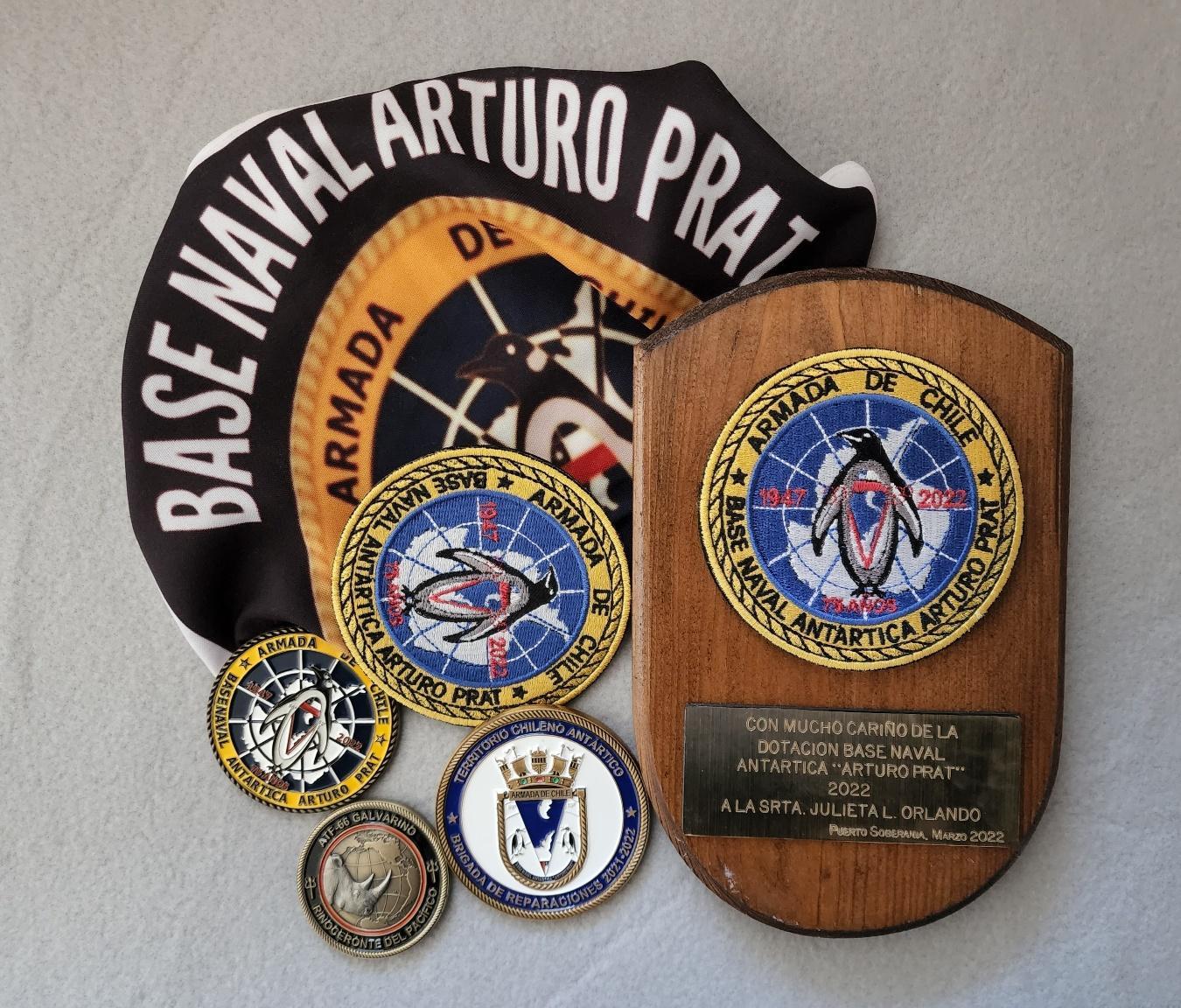
Within the framework of the Antarctic Scientific Expedition (ECA 58) of the Chilean Antarctic Institute (INACH), the naval institution highlighted the scientific career of Dr. Julieta Orlando, who stayed more than 30 days at the Captain Arturo Prat Naval Base , belonging to the Chilean Navy.

Julieta Orlando, Doctor of Sciences in Microbiology and deputy director of BASE Millennium Institute received recognition for teamwork, scientific performance in the field, direction of logistics and polar coordination. T

he Official Lieutenant Commander of the Sea, Eduardo Domínguez, who currently serves as Commander of Captain Arturo Prat Naval Base, highlighted Orlando’s 10 years of Antarctic experience, through the delivery of a Chilean Navy Coin: “I have had the opportunity to live in an INACH shelter, in scientific bases from the Army, the Navy, I have camped and sailed in seven different ships,” said the microbiologist, valuing the diversity of experiences she has obtained from Antarctic expeditions.

Arturo Prat Base, of the Chilean Navy, was a destination that emerged as a change of plans on the route, observes Dr. Orlando, since the Antarctic Scientific Expeditions (ECA) require coordination between teams and resource optimization. With this objective, she coordinated the collection of samples of the Neobuccinum eatoni snail for one of her colleagues, thus extending her southern stay from February to March 2022.

Between cueca dances, 24/7 gatherings and experiences of camaraderie and collaboration, Dr. Orlando was able to learn about the implications of a long-term stay in a base in Antarctic territory: “Being on the continent, one has the possibility of seeing different realities. It is different to be in a base of the Chilean Navy, in one of the Chilean Army, or in a facility where only civilians stay; as it is also very different to be on land than sailing”, says Julieta Orlando.

The gesture of the Naval Base Arturo Prat 2022 complement , is valued by the deputy director of the BASE Millennium Institute: “I feel very grateful, but I also feel that this is not an award, but rather the result of what Antarctic coexistence generates, and that has many edges. I feel that, even if I return to the same place, the experience is always different, and this expedition in particular was different because, unlike other opportunities, I was the only representative of our team of researchers, and I was able to adapt in a good way with the group at the base”, she reflects.

By: Constanza Barrientos.  


The agreement places scientific collaboration at the center of the institutional work, and it includes support for undergraduate and postgraduate students, academics and researchers, as well as the development of infrastructure and equipment for activities, programs and projects.

With the aim of promoting research, education and conservation of biodiversity in the Antarctic and sub-Antarctic regions, BASE Millennium Institute and the Institute of Ecology and Biodiversity (IEB) signed an institutional scientific collaboration agreement with the focus on human capital training.

The Faculty of Sciences of the University of Chile hosted the meeting between both institutions: “The members of BASE Millennium Institute have links with the IEB center and, in particular, several of our researchers have been trained in the institution, which facilitates our integration in the search for measures to implement and improve the conservation of Chile’s natural resources”, said Dr. Elie Poulin, Director of BASE Millennium Institute.

Dr. Aníbal Pauchard, Director of IEB highlighted the possibility of strengthening scientific work with a greater impact for society: “Integrate knowledge between these different centers of excellence, to the extent that these associations and cooperation agreements are made.”

The collaboration agreement, in addition to providing human, technical, logistical, infrastructure and equipment resources, seeks to develop joint actions focused on conservation and scientific communication to a wide audience: “We hope to contribute with new approaches, models and study sites to strengthen the development of cutting-edge research on biodiversity at the national level” highlighted Dr. Julieta Orlando, Deputy Director of the BASE Millennium Institute.

In terms of research, both centers will develop scientific collaborations and information exchange in the areas related to status and trends, integrity of ecosystems, agents of change in biodiversity, global warming and climate change, conservation and governance. At the same time, the support to undergraduate and postgraduate students, academics and researchers is planned, as well as the development of infrastructure and equipment for activities, programs and projects that are of interest to both the BASE Millennium Institute and the IEB.

Text: Constanza Barrientos and Carolina Todorovic.
Photos: BASE Millennium Institute / J.Orlando

Fernando Valenzuela (Gerente de IEB), Yasna Pardo (Directora ejecutiva), Aníbal Pauchard (Director IEB), Elie Poulin (Director Instituto Milenio BASE), Julieta Orlando (Directora alterna del Instituto Milenio BASE), Ramiro Bustamante (Secretario IEB) y Francisco Squeo (Presidente directorio IEB).

The student Constanza Paz Millán Medina obtained her Master of Science degree from the University of Chile, in a research led by Dr. Elie Poulin -director of the BASE Millennium Institute- as thesis director, and in a project carried out during the pandemic.

With the title “Patterns of genetic diversity and contemporary population structure in Siphonaria lateralis in the Southern Ocean”, the student Constanza Paz Millán Medina defended her thesis to qualify for the degree of Master of Science at the University of Chile, in a research that sought to evaluate the spatial genetic structure and the existence of contemporary gene flow of the limpet Siphonaria lateralis through SNP markers throughout its sub-Antarctic distribution, including populations from South America, Malvinas, South Georgia and the Kerguelen Islands. The study of these species is very relevant to understand the processes at the origin of the biogeography of the Southern Ocean, since it is only dispersed by means of large macroalgae, very abundant in sub-Antarctic areas.

The research was carried out within the framework of the Genomics Antarctic Biodiversity Ring (GAB) project and led by researchers from BASE Millennium Institute. Dr. Elie Poulin, as thesis director, and Dr. Nicolás Segovia and Dr. Claudio González-Wevar, as co-supervisors. In the defense ceremony, researchers Juliana Vianna and David Veliz participated as guest professors.

Millán highlighted that the species Siphonaria lateralis keeps a contemporary genetic connectivity between geographically distant locations of its distribution in the Southern Ocean, separated by thousands of kilometers, with the exception of the populations collected in the Malvinas Islands, which show to be genetically isolated and with a fairly endemic genetic diversity. At the same time, the SNP markers complement the history of Siphonaria lateralis previously described by traditional markers (DNA sequences).

The members of the evaluation commission highlighted the work of Millán Medina, considering the complexities of obtaining data, amid the COVID-19 pandemic. The thesis director, Elie Poulin, Ph.D. in Ecology and Evolution from University of Montpellier II, France, highlighted the research by pointing out that “the dispersal transport by rafting of gene flow is a very little explored area”, while Dr. Nicolás Segovia highlighted the level of research and the contribution to the polar discipline. Finally, Dr. Claudio González-Wevar joined in the congratulations and pointed out that the “idea that arises with traditional markers, which is added to a next stage, and is answering fundamental questions that we are asking to ourselves.”

Finally, the new Master in Sciences from the University of Chile, Constanza Paz Millán Medina, thanked her research tutors and reflected on the challenges that persist in the white continent: “The future does not look very auspicious for Antarctica under certain climate change models. Something that could be invasive, with high resilience to climatic conditions, could be able to enter all these subantarctic islands.”