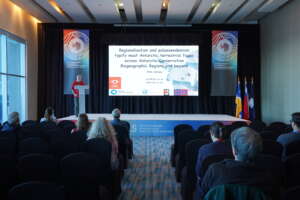
With a 16-member delegation, the BASE Millennium Institute is taking part in the 12th SCAR Open Science Conference, one of the leading international gatherings dedicated to Antarctic research. Scientists and professionals from the ANID centre of excellence travelled to Oslo to share research findings, experiences, and progress in the study and communication of the frozen continent.
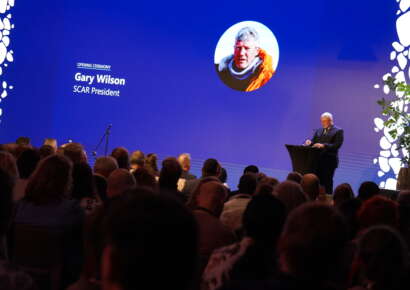
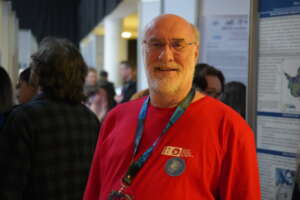
Dr. Gary Wilson, President of the Scientific Committee on Antarctic Research (SCAR) and expert in marine geology and polar climate change. Photo: Constanza Barrientos.
During August, Oslo becomes one of the world’s main meeting points for Antarctic research. The Norwegian capital is hosting specialists from different countries and disciplines in a programme with around 50 scientific sessions, aimed at sharing new knowledge and strengthening international collaboration around Antarctica and the Southern Ocean.
Once again, the BASE Millennium Institute is joining the 12th Open Science Conference of the Scientific Committee on Antarctic Research (SCAR), with a delegation that includes principal investigators Elie Poulin (University of Chile), Karin Gérard (UMAG), Luis Valentín Ferrada (Law, University of Chile), César Cárdenas (INACH) and Hugo Benítez (UNAB/CHIC), together with senior researchers Pete Convey (BASE) and Steven Chown (Monash University).
They are joined by a new generation of researchers who will present progress and results from their work in Antarctic science. Among them are early-career researchers: Daly Noll (U. Lagos), Giovannina Sutherland (Law, University of Chile / ICLAC), Jordan Hernández (UCM), Franco Cruz (Universidad Santo Tomás), Albert Palomino (UACh), Miguel Ángel Salazar (University of Rennes), Eduardo Pizarro (PUC/CRG) and Morgane Durand (National Museum of Natural History of France).
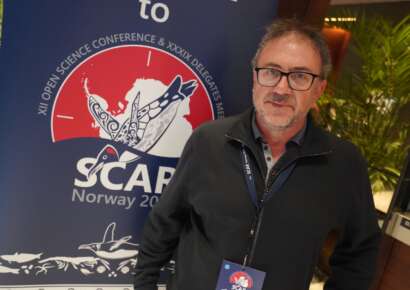
Dr. Elie Poulin takes part in thematic roundtables and the presentation of scientific results. Photo: Constanza Barrientos.
“Taking part in SCAR once again, with a diverse delegation, allows us to share the knowledge we are generating at the BASE Millennium Institute and, at the same time, strengthen our ties with an international scientific community that will be essential for the challenges ahead. We are moving towards milestones of great relevance for polar science, such as the next International Polar Year: 2032-2033, and these spaces are key to building new collaborations and scientific questions from now on,” highlights Elie Poulin, director of the BASE Millennium Institute and faculty member at the Faculty of Sciences of the University of Chile.
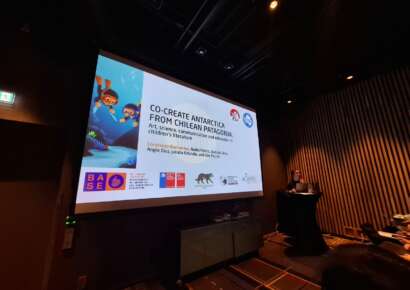
Constanza Barrientos presents the upcoming BASE book “We dive with mum… in Antarctica!” (Editorial SurCiencia). Photo: Giovannina Sutherland.
The Communications and Education Directorate (DIRECOM) is also represented by science journalist Constanza Barrientos, who will give three oral presentations and a poster. Her participation will share Antarctic science outreach experiences developed by the BASE Millennium Institute to bring polar knowledge closer to different audiences.
The presentations by the also president of the Chilean Antarctic Youth Coalition Foundation, in Punta Arenas, will address experiences in children’s literature, Antarctic education, Artificial Intelligence and new technologies, showing how different languages, formats and tools can help broaden the social reach of knowledge generated about Antarctica.
By: Nadia Politis
Photographs: Constanza Barrientos from Oslo, Norway.
Dr Peter Convey has forged a close relationship with Chile, working actively with national teams in the study of subantarctic biodiversity. Visiting the Molecular Ecology Laboratory (LEM) at the University of Chile, the terrestrial ecologist – with nearly 40 years of experience at the British Antarctic Survey (BAS)– reflects on scientific collaboration, Antarctic biodiversity, and the future of the frozen continent.
A journey that linked the United Kingdom with Puerto Williams, and concluded in Santiago de Chile by projecting new scientific collaborations: this is how terrestrial ecologist Dr Peter Convey summed up his year so far. During his visit to Chile, he described his connection with the country as a “long-standing relationship”. For the BAS scientist, we are facing a crucial moment for research into adaptation, biodiversity, and biogeography – areas in which science plays a fundamental role.
Dr Peter Convey and Dr Claudia Maturana during the BASE/PONANT expedition to Antarctica and the South Georgia Islands in 2023. Credit: Dr Tamara Contador.
– What aspects define biodiversity?
It is complex to define Biodiversity, and that is something most people are not familiar with. One element of biodiversity is the count of species. Other elements relate to aspects such as their abundance, what population sizes exist and what kinds of traits they have that allow them to survive in their environment. That may not seem like biodiversity.
– And regarding knowledge of Antarctic biodiversity?
Most of the organisms that live in Antarctica are unfamiliar to most people, even the small invertebrates. I could show them in gardens or forests here and most people would not know they exist. Here, you can find very close relatives of the same organisms that live in Antarctica. However, most people have never learnt about them or realised they exist. In addition, there are many truly microbial groups that can only be observed with a microscope.
Dr Convey is a terrestrial ecologist with nearly 40 years of experience in polar ecosystem research, having worked on 15 summer campaigns and one winter in Antarctica, as well as on various Arctic expeditions in Svalbard (Norway). His work at the British Antarctic Survey (BAS) has made him a reference in the study of biodiversity and the effects of climate change in polar regions.
Dr Peter Convey and Dr Tamara Contador in the Falkland Islands / Islas Malvinas during the SAERI expedition in 2024. Credit: Dr Tamara Contador.
Science from the end of the world
The senior researcher at the BASE Millennium Institute has established a strong connection with the Chilean scientific community, especially through his collaboration with Dr Tamara Contador, researcher at the BASE Millennium Institute. Their joint work has expanded knowledge about Antarctic terrestrial ecosystems and their response to environmental pressures. This collaboration has been fundamental in strengthening Chile’s role in polar research, promoting participation in international projects and the development of conservation strategies.
The Honorary Professor at the School of Biosciences, University of Birmingham (United Kingdom), has also been a key actor in shaping international scientific priorities through the Scientific Committee on Antarctic Research (SCAR). He has worked on programmes such as Evolution and Biodiversity in Antarctica and Regional Sensitivity to Climate Change in Antarctica, contributing to the understanding of biological evolution under extreme conditions and the impacts of climate change. His studies have demonstrated the resilience and adaptation capacity of Antarctic biodiversity, providing key data for the conservation of these fragile ecosystems.
Through collaboration with the Wankara Laboratory of Subantarctic and Antarctic Freshwater Ecosystems, the University of Magallanes (UMAG), and the Cape Horn International Centre for Global Change Studies and Biocultural Conservation (CHIC), in addition to the BASE Millennium Institute, the research line led by Dr Tamara Contador (UMAG/CHIC/BASE/INVASAL) has established bridges between science and education through – for example – environmental workshops at the Omora Ethnobotanical Park in the city of Puerto Williams.
Dr Peter Convey, Dr Tamara Contador, Dr Sebastián Rosenfeld and Dr Claudia Maturana in the field during the BASE/PONANT expedition to Antarctica and the South Georgia Islands in 2023. Credit: Dr Tamara Contador.
The research, highlighted in the article “Discovering the role of insects in climate resilience”, emphasises the importance of Parochlus steinenii as an essential biological indicator for understanding how Antarctic ecosystems respond to climate change. Initially, Dr Contador’s research focused on Parochlus steinenii, an insect that inhabits the South Shetland Islands, but is also found in South Georgia and at the southern tip of South America, in the Cape Horn archipelago. “That immediately led us to become interested in its physiology, how it survives in its environment, its morphology and its biogeography, that is, how long the different populations have been there,” explained Dr Convey.
In his role as a science communicator, the British Antarctic Survey researcher has also played an active role in education and outreach of Antarctic and polar research. His participation as a STEM Ambassador and his teaching work in various universities reinforce the importance of international collaboration in Antarctic science.
Dr Peter Convey at the XI Open Conference of the Scientific Committee on Antarctic Research (SCAR) in Pucón, Chile, in 2024. Credit: Constanza Barrientos.
– In what way could scientific knowledge be communicated to the public?
I believe one of the most spectacular things about Antarctica is its uniqueness. The environment, the ice, the penguins are so different from everything else we have seen. The biodiversity of Antarctica is unique, especially because many species exist only there. Penguins, for example, although common in other latitudes, only inhabit Antarctica. The conservation of its biodiversity is essential, and a species does not need to be large or colourful to be important. In addition, biodiversity in Antarctica is complex, with different unique regions within the continent. We must protect all that biodiversity, and as a Chilean foreigner, I recognise that it is a unique example of global biodiversity. There are mechanisms to protect it through the Antarctic Treaty, but to do so, we need to know it better. Despite human risks, Antarctica remains largely pristine, and we are still in a position to contribute to its protection.
“Changes in Antarctica have profound consequences for all of us,” notes Dr Peter Convey, also Visiting Professor of Polar Biology at the Department of Zoology, University of Johannesburg, South Africa. Reflection that arises after referring to the VIII Chilean Congress of Antarctic Research (CCIA) which, together with the XII Latin American Congress of Antarctic Science (CLCA), was held in Valdivia from 28 July to 1 August 2025, as well as the XIV International Symposium on Antarctic Earth Sciences (ISAES), held from 18 to 22 August 2025 in Punta Arenas, which once again brought Convey to the Magallanes and Chilean Antarctic region. Instances that seek to exchange knowledge and promote the exchange of ideas around Antarctic and subantarctic science.
Dr Peter Convey presenting at the XIV International Symposium on Antarctic Earth Sciences. Credit: Constanza Barrientos.
“A new year of relevance for Antarctic science in Chile,” underlines the British polar researcher, referring to 2025 as the “International Year of Glacier Preservation” declared by the UN and accompanied by the proclamation of 21 March each year as World Glacier Day. An opportunity to raise public awareness worldwide about the fundamental role of glaciers, as well as about the economic, social and environmental repercussions of the imminent changes in the Earth’s cryosphere, notes the international body.
Dr Peter Convey warned about the need to take urgent measures to conserve Antarctica, one of the last pristine environments on the planet. “We are in a position where we can make a great contribution to protecting it,” he affirmed, stressing that “the knowledge we obtain today is crucial to protect these ecosystems in the future.”
He also highlights the importance of international cooperation in polar research, mentioning his work with Chilean institutions such as the BASE Millennium Institute and the University of Magallanes. In this regard, he calls for strengthening research with more resources and global commitment: “We still have time to do things right. Antarctica is one of the last pristine spaces on the planet and we have the responsibility to protect it for future generations,” concluded the Antarctic-subantarctic researcher.
By Benjamín Groff and Nadia Politis
Edited by Constanza Barrientos
Photographs: Tamara Contador, Constanza Barrientos and Nadia Politis / BASE Millennium Institute
References:
Chown, S.L. et al. (2022). Antarctic Climate Change and the Environment: A Decadal Synopsis and Recommendations for Action. SCAR, Cambridge.
Cannone, N. et al. (2022). Acceleration of climate warming and vascular plant expansion in maritime Antarctica. Current Biology, 32, 1-8. DOI: 10.1016/j.cub.2022.01.074.
Bokhorst, S. et al. (2022). Temperature impact on the influence of penguin-derived nutrients and mosses on non-native grass in a simulated polar ecosystem. Global Change Biology, 28, 816–828. DOI: 10.1111/gcb.15979.
The project led by the BASE Millennium Institute of Chile and the University of Burgundy of Dijon, France, seeks to establish a coastal observation network to identify exotic species present in marine ecosystems and promote international collaboration and knowledge exchange.
Patagonia, Kerguelen islands and the Antarctic peninsula are the regions whose coasts will be monitored by the project led by PhD. Elie Poulin, from theBASE Millennium Institute, and PhD. Thomas Saucède from the University of Burgundy. An initiative financed by the National Research and Development Agency (ANID) and the Evaluation and Guidance Committee of Scientific Cooperation with Chile of the Government of France (ECOS).
The project, which lasts three years (2023-2025), aims to establish an observing network for detection of exotic subantarctic and Antarctic species and monitor marine biodiversity using Autonomous Reef Monitoring Structures (ARMS), through the metabarcoding technique. This molecular technique allows the identification and quantification of species in water and sediment samples based on the DNA present in them.
The director of the BASE Millennium Institute and academic at the University of Chile (UCh), PhD. Elie Poulin, points out that “these species, introduced by human activities in non-native ecosystems, can have negative consequences on biodiversity and pristine ecosystems. The initiative seeks to improve understanding of the presence and potential impacts of these species through extensive monitoring in key areas. The project hypothesis states that many of these exotic species do not survive underwater winter temperatures, which keeps them unknown in conventional biodiversity records”.
The ECOS-ANID project “Monitoring of subantarctic alien species in Antarctic Peninsula: setting-up a network of nearshore observing systems in Patagonia, Kerguelen and Antarctica”, has a team of professionals from different regions of Chile and France. From the BASE Millennium Institute: PhD. Karin Gerard (University of Magallanes CIGA UMAG, CHIC, LEMAS), PhD. Angie Díaz Lorca (University of Concepción), Carolina Pérez Troncoso (master’s student at the University of Magallanes), Sebastián Rosenfeld (doctoral student at the University of Chile, CHIC, Apecs Chile) and Erwan Courville (University of Burgundy), From the Sorbonne University, with PhD. Cyrill Gallut.
International collaboration and knowledge exchange
PhD. Thomas Saucède has been collaborating for more than ten years with researchers from the BASE Millennium Institute, in biogeography and phylogeography of marine invertebrates (mollusks, echinoids and fish). Regarding the current project, he points out that “it is a good opportunity to continue collaborating based on our good complementarity in terms of access to the field and to samples throughout the Southern Ocean”.
“It allows us to unite and collaborate in areas such as Patagonia and Antarctica, on the part of the Millennium BASE Institute, and in the subantarctic archipelagos of Crozet and Kerguelen, on my part. “We also complement each other in terms of methodology (genetics, genomics, morphology, taxonomy, biogeography, paleontology) to address important questions related to the origin, evolution and sensitivity of marine species to climate changes at the scale of the Southern Ocean in a comprehensive manner”, he adds.
From left to right: Ewan Courville, PhD. Thomas Saucède and PhD. Elie Poulin. Photo: BASE Millennium Institute / Carolina Gajardo
During March 2024, PhD. Thomas Saucède spent two weeks in PhD. Elie Poulin’s laboratory at the UCh, working alongside the doctoral student, Erwan Courville, who develops his thesis under co-tutorship with both researchers. Erwan is doing a phylogenetic and biogeographic study of the sea urchin genus Arbacia.
“This mobility program gives us the opportunity to co-tutor and train master’s and doctoral students between Chile and France in molecular ecology. Erwan Courville is currently completing a comprehensive phylogenetic and biogeographic study of the echinoid genus Arbacia, including the southern species. “We are working on publishing his results and completing his doctoral thesis”, says the Burgundy University academic.
By: Carolina Gajardo y Constanza Barrientos
Main image: Karin Gerard
The alternate director of the Millennium BASE Institute, Julieta Orlando, emphasized the significance of the white continent for the planet, during a keynote talk organized by the Center for Research and Advanced Studies of the Universidad Católica del Maule.
BASE Millenium Institute associate researcher, PhD. Hugo Benítez, and alternate director of the BASE Millennium Institute, PhD. Julieta Orlando. Photo: BASE Millennium I.
“Protecting Antarctic biodiversity is important for humanity”. With this statement, the alternate director of the Millennium BASE Institute, Julieta Orlando, emphasized why the frozen continent is considered the heart of the planet, during a master lecture she gave at the Universidad Católica del Maule (UCM).
“While Antarc tica looks remote and isolated, it is very interconnected. What happens there can affect other latitudes, including permanent human settlements, and therefore the protection of that biodiversity not only takes care of that balance, but also the global one”, said the associate professor of the University of Chile in the activity organized by the Center for Research and Advanced Studies of Maule (CIEAM, in Spanish), belonging to the campus.
The event, which was attended by the dean of the Faculty of Agricultural and Forestry Sciences of the institution, Claudio Fredes, was aimed at commemorating Antarctica Month.
CIEAM Researcher, PhD. Alexis Castillo. Photo: Universidad Católica del Maule
“It is also important to maintain the balance in this territory because there are many resources within the biodiversity that are not yet known but could prove useful in the future”, stated the PhD of Sciences, who has made several contributions to polar research, considers both charismatic and well-known organisms, as well as imperceptible microorganisms that could mitigate climate change.
The scientist has participated in ten expeditions to the southernmost continent in the world, which celebrates its day every November 6, commemorating the milestone established by former President Pedro Aguirre Cerda when he defined the limits of the Chilean Antarctic Territory in 1940.
PhD. Julieta Orlando, alternate director of the BASE Millennium Institute. Photo: BASE Millennium I. / N. Politis
“The Chilean Antarctic Institute, INACH, envisions Antarctica being recognized not just on a specific day, but throughout a whole month, so that all people, even from Arica, Iquique or Antofagasta, can feel that this territory is an integral part of their country and the planet”, she emphasized.
In addition to Orlando, doctors Aparna Banerjee, Alexis Castillo and Felipe Gordillo, as well as the director of CIEAM and researcher at the Millennium BASE Institute, PhD. Hugo Benítez, shared their experiences on the white continent.
“The center has two Antarctic science projects that were awarded two years ago. With this event, we aimed to showcase our high-level research in the Antarctic environment, and invite students to participate of it with internships and doctoral or master’s theses”, said Benítez.
The project promoted from the Magallanes region by the Patagonian Institute of Cultural Studies (INPAEC), in collaboration with researchers from the BASE Millennium Institute, is now available on Spotify, Ivoox and the INPAEC YouTube channel.
“Bitácora Antártica” (Antarctic Logbook) is the name of the new scientific outreach podcast that seeks to reflect on Antarctica from the perspective of Anthropology, History, Science, Geology and Biodiversity. The proposal, promoted by the Patagonian Institute of Cultural Studies (INPAEC), and its director, Sociologist Silvio Reyes Rolla, seeks to discuss the Antarctic continent and its connection with people and knowledge, from a close, entertaining and reflective format: “We wanted to highlight Science as an agent of change that today is the protagonist of the great reflections of the future”, says Reyes, who is also a poet and cultural mediator.
Through 10 episodes of 40 to 50 minutes, researchers linked to Antarctica reflect on the challenges in the continent and how the Academy, Science and Civil Society work for its protection and awareness, a project in which the BASE Millenium Institute joined, with the participation of five of its researchers: PhD. Elie Poulin, PhD. Julieta Orlando, PhD. Juliana Vianna, PhD. Pablo Guerrero and PhD. Andrea Piñones.
Silvio Reyes Rolla is a Sociologist, Poet, Cultural Mediator and Director of the Patagonian Institute of Cultural Studies (INPAEC).¿
In chapter five, PhD. Andrea Piñones (BASE Millennium Institute, UACh, IDEAL, COPAS) reflects on ecogeographic elements of Antarctica and the so-called trophic chain (Premiere chapter: May 12, 2023). While in chapter six, PhD. Juliana Vianna (BASE Millennium Institute, PUC, CRG, Núcleo Milenio LILI) details the scientific work carried out with Penguins (Premiere chapter: May 15, 2023).
In chapter seven, PhD. Pablo Guerrero (BASE Millennium Institute, UdeC, IEB) gives details about his research on Antarctic plants (Premiere chapter: May 17, 2023), and on the other hand, chapter eight, PhD. Elie Poulin (Instituto Milenio BASE, Uchile) refers to pollution, invasive species and tourism developed in Antarctica (Premiere chapter: May 19, 2023). Finally, in chapter nine, PhD. Julieta Orlando (Instituto Milenio BASE, Uchile) reflects on Bioremediation and antibiotic resistance (Premiere chapter: 22 May 2023).
The podcast “Bitácora Antártica” (Antarctic Logbook), a popularization of history and science about the frozen continent and sub-Antarctic geography, is now available on Spotify, Ivoox and the INPAEC YouTube channel. The proposal has the musical collaboration of the Magellanic group Lluvia Ácida, with the song “Camino de la Ballena”, from the album Archipiélago Coloane. More information at https://www.inpaec.com/bitacora-antartica/
Chapters of “Antarctic Logbook”.
History of Antarctic research. Phd Marcelo Leppe Chapter premiere: May 2, 2023
Antarctic Treaty from the history. Rodrigo Santibáñez Chapter premiere: May 5, 2023
Human condition of research in the Antarctic field. Anthropologist Florencia Vergara – Chapter premiere: May 8, 2023
Geological conformation of Antarctica. Phd. Luis Jara Premiere episode: May 10, 2023
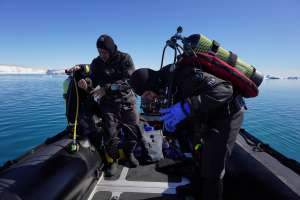
The director of the Millennium Institute for Biodiversity of Antarctic and Subantarctic Ecosystems (BASE), Dr. Elie Poulin, with the director of the Millennium Nucleus for the Ecology and Conservation of Temperate Mesophotic Reef Ecosystems (NUTME), Dr. Alejandro Pérez-Matus dived in the Weddell Sea, Antarctica, on a 15-day international expedition that took them to the inhospitable Larsen B ice shelf.
Santiago, January 13, 2023.- The exchange of disciplinary experiences, together with the incorporation of new research methodologies, was the objective of the polar expedition carried out between the centers of excellence of the National Agency for Research and Development (ANID); Millennium Institute for Biodiversity of Antarctic and Sub-Antarctic Ecosystems (BASE) and Millennium Nucleus for the Ecology and Conservation of Temperate Mesophotic Reef Ecosystems (NUTME).
Picture of: Millennium I. BASE/ N. Politis
For the director of the BASE Millennium Institute and academic from the University of Chile, Dr. Elie Poulin, the collaboration meant fundamental support in scientific work in the field, and opened up new possibilities for carrying out projects: “In highly demanding conditions, as it is to carry out scientific diving in Antarctica, it is essential to have disciplinary experience that allows operations to be carried out safely and successfully. Therefore, working with NUTME was a fantastic experience, which we hope to be able to repeat again”, he said.
Meanwhile, the director of the Millennium Nucleus for the Ecology and Conservation of Temperate Mesophotic Reef Ecosystems (NUTME), Dr. Alejandro Pérez-Matus, carried out his first polar expedition, diving in waters as low as -1.5°, and incorporating highly complex equipment in the dives: “We carry out sampling of marine invertebrates and fish, having the possibility of using BRUVs (Baited Remote Underwater Video cameras). This allowed us to observe fish and species for longer than during a scuba dive, which is limited by cold to just a few minutes. In addition, we take underwater photographs to characterize the seabed and associated species. Finally, we managed to extract seawater at the depths visited to carry out environmental DNA filtering in the on-board laboratory”, he pointed out.
Picture of: Millennium I. BASE/ D. Ramírez
During the 15-day expedition that both centers of excellence carried out on board the French ship Le Commandant Charcot, and within the framework of an international collaboration between SEDNA Expeditions and the Instituto Milenio BASE, more than 12 dives were made in the cold Weddell Sea, with long hours of daily work.
Marine invertebrates and fish were collected during the dives for genetic studies, along with high-quality photography and video of Antarctic organisms and unexplored underwater environments. Both centers will share their experiences in Antarctica, through scientific dissemination activities that they will announce jointly at https://institutobase.cl and https://nutme.cl
By: Direction of Communications Millennium Institute BASE
Main picture: A. Pérez-Matus
The meeting held from September 21st to 23rd in the region of Magallanes and Chilean Antarctic, brought together principal and associate researchers from Millennium Biodiversity Institute of Antarctic and Sub-Antarctic Ecosystems (BASE) to review the progress and plan new projects.
Among the topics addressed at the first annual BASE Millennium Institute meeting, were the definition of cross-cutting study models, upcoming Antarctic expeditions, international collaboration and decentralization challenges. The meeting took place at Almasur Hotel in Punta Arenas. The SEREMI of Science of the Austral Macrozone, Verónica Vallejos, and the director of the Chilean Antarctic Institute (INACH) Marcelo Leppe participating in the event highlighted the opportunity to learn more about what BASE Millennium Institute proposes, mainly because it closely approximates the principles that the ministry has within this government: “It is a pleasure to see that there are young women researchers who are participating in the project,” Vallejos said.
Dr. Ellie Poulin, director of the BASE Millennium Institute stressed the importance of this milestone since it is the first time that the researchers of the BASE Millennium Institute gather off screen to finally establish a work plan -all together- and develop strategies to generate interdisciplinary and transdisciplinary collaboration, since the institute not only contemplates biology studies, but also conservation and Antarctic governance.
“We were indebted in many aspects of the studies -mainly in marine ecosystems- and with a strong approach in evolutionary biology, biodiversity and of course the component of time, which is Climate Change”, stressed Marcelo Leppe, director of INACH.
Finally, in terms of challenges, Dr. Julieta Orlando, alternate director of BASE Millennium Institute, pointed to knowledge management and team articulation: “to focus on certain models that allow us to work together, comprehensively, to make a real interdisciplinary, and transdisciplinary work, taking advantage of the experiences and expertise that each of the researchers have”.
The meeting ended by highlighting the link made with research centers such as the Institute of Ecology and Biodiversity (IEB), the Cape Horn International Center for Global Change Studies and Biocultural Conservation (CHIC), and the Research Center for Dynamics of High Latitudes Marine Ecosystems (IDEAL).
By: Constanza Barrientos and Nadia Politis
Audiovisual: Patricio Moreno, Triada Producciones
Translated by: Catalina Ovando
Antarctic chatbotBASE Millennium Institute Project
Type your message to contact us on WhatsApp
Hi! I'm an Antarctic krill ❄️ 🦐
And I'll be your guide to learn more about Antarctica. Do you have any questions? 👇