As part of its participation in the 61st Antarctic Scientific Expedition (ECA61) of INACH, the team from the UC Molecular Biodiversity Laboratory, led by Dr. Juliana Vianna, crossed the Antarctic Circle to enhance the surveillance and monitoring of Highly Pathogenic Avian Influenza (H5N1) in the frozen continent.
Punta Arenas.—Under strict biosecurity measures and in coordination with the Chilean Antarctic Institute (INACH), the Chilean Navy, Army, and Air Force, scientists Dr. Fabiola León, Claudia Ulloa, and Carolina Márquez embarked on their scientific journey aboard the Betanzos vessel, operated by DAP. Their mission is to collect samples and conduct laboratory analyses as part of their work at the UC Molecular Biodiversity Laboratory, led by Dr. Juliana Vianna (BASE/CRG, Lili, UC Institute for Sustainable Development), in collaboration with the Millennium Institute BASE.
“After successfully detecting positive cases of Highly Pathogenic Avian Influenza (H5N1) in Antarctica during the ECA60 expedition of INACH in January 2024, we have been working diligently to analyze samples and coordinate research teams studying birds such as penguins, cormorants, and skuas in Antarctica,” says Dr. Juliana Vianna, a Ph.D. in Biological Sciences with a specialization in Ecology and a faculty member at UC.
The Antarctic scientist, who also serves as the deputy director of the Millennium Institute CRG, highlights the importance of studying wildlife health in Antarctica due to the connectivity between species and the continent’s crucial role in global ecosystem balance. “The migration and movement of species can influence the spread of avian influenza, potentially increasing mortality rates. This underscores the importance of continuing field studies to monitor affected areas and species,” emphasizes Dr. Vianna.

Throughout 2023-2024, the collection and analysis of samples in Antarctica were coordinated by researchers Dr. Fabiola León (UC/BASE/CRG, Lili) and Eduardo Pizarro (UC/BASE/CRG), with international support from the vessel Le Commandant Charcot, operated by Ponant Cruises. In 2025, the research is being conducted aboard the Betanzos vessel, part of the DAP group, reaching beyond the Antarctic Circle into the so-called “deep Antarctica,” specifically in Lagotellerie Island and Aves Island in Margarita Bay.
“Our field experience has been essential in ensuring safe and rigorous scientific work under strict biosecurity measures. It is important to highlight that our campaigns cover a wide geographic range and are conducted at different times of the season, allowing for surveillance over a timeline that helps determine the status of avian influenza at various stages of the nesting season for both flying and non-flying birds,” says Dr. Fabiola León. Her research has taken her to sample emperor, Adélie, gentoo, and king penguins in locations such as Snow Hill Island, Danger Islands, Red Rock Ridge, Cape Hallett, and Sims Island.
Essential biosecurity measures
The “Prevention and Control Protocol for Highly Pathogenic Avian Influenza (HPAI) in Antarctica,” issued by the Chilean Antarctic Institute (INACH), aligns with international recommendations from the Scientific Committee on Antarctic Research (SCAR). These biosecurity measures apply to all expeditions taking place from January to March 2025 in Antarctica and follow the “One Health” guidelines for preserving the health of the unique and fragile Antarctic ecosystem.
“The study of avian influenza and its evolution is essential for understanding viral dynamics and global public health. At our Millennium Institute BASE, we are committed to scientific excellence, working rigorously and collaboratively to address this constantly evolving phenomenon. High-quality science not only allows us to obtain accurate results but also provides the necessary tools to anticipate and mitigate risks associated with the spread of infectious diseases,” states Dr. Elie Poulin, director of the Millennium Institute for Antarctic and Sub-Antarctic Ecosystem Biodiversity.
As part of these protective efforts, Personal Protective Equipment (PPE) plays a crucial role. As indicated by the Chilean Institute of Public Health (ISP), PPE includes specialized gear, apparatus, or devices designed to protect the body—either partially or entirely—from specific risks. These measures help prevent occupational diseases, reduce accidents, and minimize their impacts.
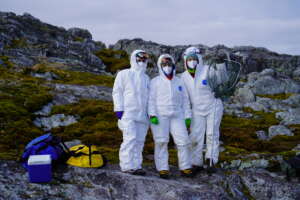
The Millennium Institute BASE/UC/CRG research team emphasizes that in Antarctica, the use of masks, gloves, and coveralls protects both people and the living organisms inhabiting the region. “Introducing new pathogens from humans to birds and mammals or unintentionally transporting and spreading them from healthy colonies to other locations is a critical concern that requires extreme caution,” they note. Additionally, pre- and post-sampling cleaning of equipment before entering any area is a mandatory part of the daily protocol during field expeditions.
“Highly pathogenic avian influenza is a major concern within the international scientific community,” states Dr. Ricardo Jaña, head of INACH’s Scientific Department. “A special group has been organized to gather and analyze evidence across different Antarctic research sites, establishing an information system through reports,” he adds.
Jaña highlights that this effort extends beyond Chile, as other countries are also contributing data from their research expeditions. “South Korea has recently reported findings in the Fildes Peninsula area, and Chile, through its campaign in Margarita Bay, has also documented cases from different bird populations,” he notes.
INACH’s Scientific Department head and expert in Natural Resources/Glaciology affirms that “this concern extends beyond Antarctica.” “In the local region, a working group led by the Ministry of Agriculture has been established, with our colleague Marcelo González serving as an institutional representative,” he concludes.
Through tools such as infographics and specialized publications, the Chilean Antarctic Institute has provided guidelines and recommendations, which can be downloaded from https://www.inach.cl/expedicion-antartica/protocolo-influenza-aviar/.
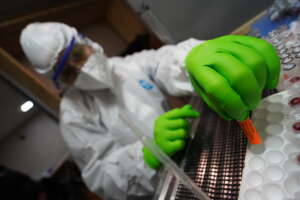
The early detection and epidemiological surveillance of highly pathogenic avian influenza (HPAI) in the Antarctic Peninsula are being led by various virology and wildlife teams from the Chilean Antarctic Institute’s National Antarctic Science Program (PROCIEN). Since 2024, two avian influenza testing laboratories have been operating at Escudero Base and O’Higgins Base to support areas of national and international interest and establish connections with the Scientific Committee on Antarctic Research (SCAR) programs.
This initiative is complemented by Antarctic governance actions, where Chile is leading an intersessional contact group under the Antarctic Treaty on Highly Pathogenic Avian Influenza. This group includes, for example, Dr. Luis Valentín Ferrada, a professor at the University of Chile and researcher at the Millennium Institute BASE.
A joint effort between universities, top-tier research institutes, and Antarctic operators underscores the significance of collaborative work and scientific research in Antarctica to understand and mitigate the risks associated with avian diseases in this unique region.
By: Nadia Politis
Photographs: Constanza Barrientos/Millennium Institute BASE
 Punta Arenas, June 2, 2023.- With the motto “Interdiscipline, Science and Future Scenarios”, researchers from all over Chile will meet from October 24 to 26 in Punta Arenas to exchange their advances in polar science and their challenges for the next years.