As part of its participation in the 61st Antarctic Scientific Expedition (ECA61) of INACH, the team from the UC Molecular Biodiversity Laboratory, led by Dr. Juliana Vianna, crossed the Antarctic Circle to enhance the surveillance and monitoring of Highly Pathogenic Avian Influenza (H5N1) in the frozen continent.

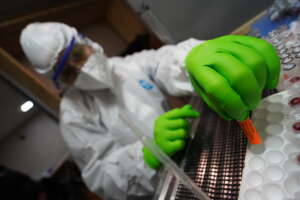
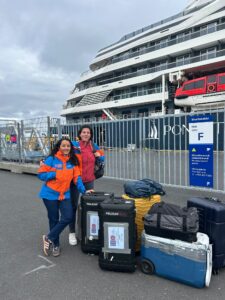
Punta Arenas.—Under strict biosecurity measures and in coordination with the Chilean Antarctic Institute (INACH), the Chilean Navy, Army, and Air Force, scientists Dr. Fabiola León, Claudia Ulloa, and Carolina Márquez embarked on their scientific journey aboard the Betanzos vessel, operated by DAP. Their mission is to collect samples and conduct laboratory analyses as part of their work at the UC Molecular Biodiversity Laboratory, led by Dr. Juliana Vianna (BASE/CRG, Lili, UC Institute for Sustainable Development), in collaboration with the Millennium Institute BASE.

“After successfully detecting positive cases of Highly Pathogenic Avian Influenza (H5N1) in Antarctica during the ECA60 expedition of INACH in January 2024, we have been working diligently to analyze samples and coordinate research teams studying birds such as penguins, cormorants, and skuas in Antarctica,” says Dr. Juliana Vianna, a Ph.D. in Biological Sciences with a specialization in Ecology and a faculty member at UC.

The Antarctic scientist, who also serves as the deputy director of the Millennium Institute CRG, highlights the importance of studying wildlife health in Antarctica due to the connectivity between species and the continent’s crucial role in global ecosystem balance. “The migration and movement of species can influence the spread of avian influenza, potentially increasing mortality rates. This underscores the importance of continuing field studies to monitor affected areas and species,” emphasizes Dr. Vianna.

The scientific work with birds in Antarctica aims to strengthen the surveillance and monitoring of Highly Pathogenic Avian Influenza (H5N1).

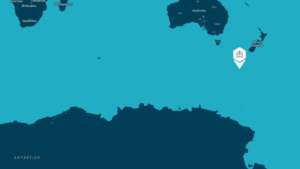
Throughout 2023-2024, the collection and analysis of samples in Antarctica were coordinated by researchers Dr. Fabiola León (UC/BASE/CRG, Lili) and Eduardo Pizarro (UC/BASE/CRG), with international support from the vessel Le Commandant Charcot, operated by Ponant Cruises. In 2025, the research is being conducted aboard the Betanzos vessel, part of the DAP group, reaching beyond the Antarctic Circle into the so-called “deep Antarctica,” specifically in Lagotellerie Island and Aves Island in Margarita Bay.

“Our field experience has been essential in ensuring safe and rigorous scientific work under strict biosecurity measures. It is important to highlight that our campaigns cover a wide geographic range and are conducted at different times of the season, allowing for surveillance over a timeline that helps determine the status of avian influenza at various stages of the nesting season for both flying and non-flying birds,” says Dr. Fabiola León. Her research has taken her to sample emperor, Adélie, gentoo, and king penguins in locations such as Snow Hill Island, Danger Islands, Red Rock Ridge, Cape Hallett, and Sims Island.

Essential biosecurity measures

The “Prevention and Control Protocol for Highly Pathogenic Avian Influenza (HPAI) in Antarctica,” issued by the Chilean Antarctic Institute (INACH), aligns with international recommendations from the Scientific Committee on Antarctic Research (SCAR). These biosecurity measures apply to all expeditions taking place from January to March 2025 in Antarctica and follow the “One Health” guidelines for preserving the health of the unique and fragile Antarctic ecosystem.

“The study of avian influenza and its evolution is essential for understanding viral dynamics and global public health. At our Millennium Institute BASE, we are committed to scientific excellence, working rigorously and collaboratively to address this constantly evolving phenomenon. High-quality science not only allows us to obtain accurate results but also provides the necessary tools to anticipate and mitigate risks associated with the spread of infectious diseases,” states Dr. Elie Poulin, director of the Millennium Institute for Antarctic and Sub-Antarctic Ecosystem Biodiversity.

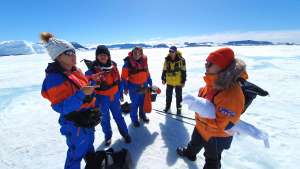
As part of these protective efforts, Personal Protective Equipment (PPE) plays a crucial role. As indicated by the Chilean Institute of Public Health (ISP), PPE includes specialized gear, apparatus, or devices designed to protect the body—either partially or entirely—from specific risks. These measures help prevent occupational diseases, reduce accidents, and minimize their impacts.

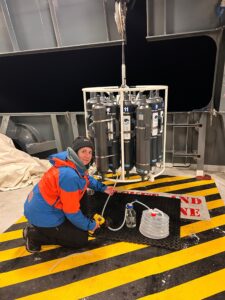
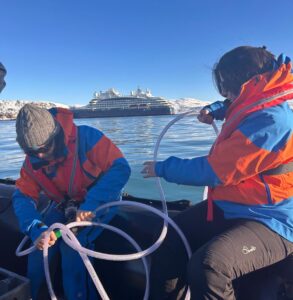
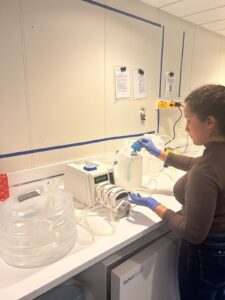
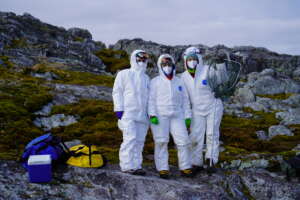
Researchers Fabiola León, Claudia Ulloa, and Carolina Márquez wear biosecurity suits for sample collection in Antarctica.

The Millennium Institute BASE/UC/CRG research team emphasizes that in Antarctica, the use of masks, gloves, and coveralls protects both people and the living organisms inhabiting the region. “Introducing new pathogens from humans to birds and mammals or unintentionally transporting and spreading them from healthy colonies to other locations is a critical concern that requires extreme caution,” they note. Additionally, pre- and post-sampling cleaning of equipment before entering any area is a mandatory part of the daily protocol during field expeditions.

“Highly pathogenic avian influenza is a major concern within the international scientific community,” states Dr. Ricardo Jaña, head of INACH’s Scientific Department. “A special group has been organized to gather and analyze evidence across different Antarctic research sites, establishing an information system through reports,” he adds.

Jaña highlights that this effort extends beyond Chile, as other countries are also contributing data from their research expeditions. “South Korea has recently reported findings in the Fildes Peninsula area, and Chile, through its campaign in Margarita Bay, has also documented cases from different bird populations,” he notes.

INACH’s Scientific Department head and expert in Natural Resources/Glaciology affirms that “this concern extends beyond Antarctica.” “In the local region, a working group led by the Ministry of Agriculture has been established, with our colleague Marcelo González serving as an institutional representative,” he concludes.

Through tools such as infographics and specialized publications, the Chilean Antarctic Institute has provided guidelines and recommendations, which can be downloaded from https://www.inach.cl/expedicion-antartica/protocolo-influenza-aviar/.

Blood Sample Analysis in Penguins Helps Study Highly Pathogenic Avian Influenza (H5N1)

The early detection and epidemiological surveillance of highly pathogenic avian influenza (HPAI) in the Antarctic Peninsula are being led by various virology and wildlife teams from the Chilean Antarctic Institute’s National Antarctic Science Program (PROCIEN). Since 2024, two avian influenza testing laboratories have been operating at Escudero Base and O’Higgins Base to support areas of national and international interest and establish connections with the Scientific Committee on Antarctic Research (SCAR) programs.

This initiative is complemented by Antarctic governance actions, where Chile is leading an intersessional contact group under the Antarctic Treaty on Highly Pathogenic Avian Influenza. This group includes, for example, Dr. Luis Valentín Ferrada, a professor at the University of Chile and researcher at the Millennium Institute BASE.

A joint effort between universities, top-tier research institutes, and Antarctic operators underscores the significance of collaborative work and scientific research in Antarctica to understand and mitigate the risks associated with avian diseases in this unique region.


By: Nadia Politis
Photographs: Constanza Barrientos/Millennium Institute BASE

Aboard the French research vessel Le Soléal (Ponant Cruises) collaborative effort between PhD. Claudio González-Wevar (UACh/BASE/IDEAL) and Professor Hamish G. Spencer (University of Otago) combines expertise in molecular genomics, evolutionary biology, and biogeography to investigate the distribution, diversity, and evolutionary history of molluscs in the Southern Ocean’s unique and understudied ecosystems. The expedition aims to advance the understanding of subantarctic molluscs through detailed collection and study.

Marking their tenth expedition, the BASE Millennium Institute and Ponant Cruises continue groundbreaking research, this time on Macquarie, Stewart and Auckland Islands, led by PhD. González-Wevar, head of the Laboratory of Antarctic and Subantarctic Molecular Genomics and Ecology (LAGEMAS-UACh). The project is also strengthened by the expertise of Professor Hamish G. Spencer, Sesquicentennial Distinguished Professor from the Department of Zoology at the University of Otago, New Zealand. Together, the team focuses on sampling and analyzing intertidal ecosystems, highlighting the importance of these islands, which host key study groups such as mollusc species Nacella (e.g., terroris, macquariensis), Laevilitorina (e.g., mcphersonae, venusta), and Margarella (e.g., violacea, macquariensis), among others.

The scientific work involves sampling from the subantarctic intertidal zone. Image: Hamish Spencer

“The participation of PhD. Hamish Spencer from the University of Otago has been invaluable. His expertise enabled us to access Stewart Island and collect specimens for our studies”, González-Wevar adds. The expedition covers rare and remote locations, including Traills Bay, the Auckland Islands in New Zealand, and Macquarie Island in Australia. These areas offer unparalleled opportunities for understanding biodiversity and ecological dynamics.

Professor Hamish G. Spencer, underscores the significance of the research: “The biogeography of the Southern Ocean is fascinating and yet understudied. Nevertheless, we have long understood that the world’s strongest oceanic current, the Antarctic Circumpolar Current (ACC), is the major physical player in the distribution of organisms in the subantarctic. In a long-standing collaboration with Professor Claudio González-Wevar of BASE, I am interested in understanding how long-distance dispersal in the ACC has shaped the marine biodiversity around the shores of the Southern Ocean. We have used molluscs as our model organisms and have previously collaborated on projects about limpets (Nacella and Siphonaria), topshells (Margarella), and periwinkles (Laevilacunaria and Laevilitorina)”.

Spencer elaborates on the mission’s goals: “We now want to expand our work to include more populations and species from the New Zealand and Australian subantarctic islands (Auckland, Campbell and Macquarie). These islands are especially important because they have acted as refugia for some species during past Ice Ages. We are aiming on this cruise to collect samples of all of the above genera, as well as some others for new projects (e.g., the bivalve Gaimardia). Our preliminary work on some of these groups suggests that there has been significant evolutionary radiation in this region, even though it is connected by long-distance dispersal to Patagonia, the Antarctic Peninsula, and the subantarctic islands in the Atlantic and Indian sectors”.

The Auckland and Campbell Islands (New Zealand) and Macquarie Island (Australia) are key sites for scientific research.


A Partnership Driving Scientific Excellence

Since 2022, the collaboration between the BASE Millennium Institute and Ponant Cruises has paved the way for groundbreaking research. “This partnership allows us to conduct more and better science while strengthening ties with world-class research teams”, says PhD. Elie Poulin, director of the BASE Millennium Institute.

PhD. Claudio González-Wevar and Phd. Hamish Spencer embarking on a subantarctic expedition.
Image: C. González-Wevar

Together with Dr. Spencer, González-Wevar delves into population genetics, phenotypic plasticity, phylogenetics, and the unique characteristics of New Zealand molluscs. The Auckland, Campbell, and Macquarie Islands are pivotal to their work, particularly Macquarie Island, which UNESCO declared a World Heritage site in 1997. This island’s geological significance, as the only location where mantle rocks are exposed above sea level, underscores its importance for scientific inquiry.

Professor Spencer concludes: “The ultimate goal of our work is to explain the origin of intertidal and nearshore Southern Ocean biodiversity, especially the range of evolutionary outcomes, from widespread species to island-group endemics”.

UNESCO highlights New Zealand’s subantarctic islands as biodiversity hotspots where Antarctic and subtropical waters converge, fostering high marine productivity and unique ecosystems. “These islands boast significant endemism, especially among birds, plants, and invertebrates”, the organization points. This biodiversity underscores the global significance of research conducted by González-Wevar and his team.


By: Nadia Politis, BASE Millennium Institute

Main picture: French vessel Le Soléal, operated by Ponant Cruises. By Hamish Spencer.

The project led by the BASE Millennium Institute of Chile and the University of Burgundy of Dijon, France, seeks to establish a coastal observation network to identify exotic species present in marine ecosystems and promote international collaboration and knowledge exchange.

Patagonia, Kerguelen islands and the Antarctic peninsula are the regions whose coasts will be monitored by the project led by PhD. Elie Poulin, from the BASE Millennium Institute, and PhD. Thomas Saucède from the University of Burgundy. An initiative financed by the National Research and Development Agency (ANID) and the Evaluation and Guidance Committee of Scientific Cooperation with Chile of the Government of France (ECOS).

The project, which lasts three years (2023-2025), aims to establish an observing network for detection of exotic subantarctic and Antarctic species and monitor marine biodiversity using Autonomous Reef Monitoring Structures (ARMS), through the metabarcoding technique. This molecular technique allows the identification and quantification of species in water and sediment samples based on the DNA present in them.

The director of the BASE Millennium Institute and academic at the University of Chile (UCh), PhD. Elie Poulin, points out that “these species, introduced by human activities in non-native ecosystems, can have negative consequences on biodiversity and pristine ecosystems. The initiative seeks to improve understanding of the presence and potential impacts of these species through extensive monitoring in key areas. The project hypothesis states that many of these exotic species do not survive underwater winter temperatures, which keeps them unknown in conventional biodiversity records”.

The ECOS-ANID project “Monitoring of subantarctic alien species in Antarctic Peninsula: setting-up a network of nearshore observing systems in Patagonia, Kerguelen and Antarctica”, has a team of professionals from different regions of Chile and France. From the BASE Millennium Institute: PhD. Karin Gerard (University of Magallanes CIGA UMAG, CHIC, LEMAS), PhD. Angie Díaz Lorca (University of Concepción), Carolina Pérez Troncoso (master’s student at the University of Magallanes), Sebastián Rosenfeld (doctoral student at the University of Chile, CHIC, Apecs Chile) and Erwan Courville (University of Burgundy), From the Sorbonne University, with PhD. Cyrill Gallut.

International collaboration and knowledge exchange

PhD. Thomas Saucède has been collaborating for more than ten years with researchers from the BASE Millennium Institute, in biogeography and phylogeography of marine invertebrates (mollusks, echinoids and fish). Regarding the current project, he points out that “it is a good opportunity to continue collaborating based on our good complementarity in terms of access to the field and to samples throughout the Southern Ocean”.

“It allows us to unite and collaborate in areas such as Patagonia and Antarctica, on the part of the Millennium BASE Institute, and in the subantarctic archipelagos of Crozet and Kerguelen, on my part. “We also complement each other in terms of methodology (genetics, genomics, morphology, taxonomy, biogeography, paleontology) to address important questions related to the origin, evolution and sensitivity of marine species to climate changes at the scale of the Southern Ocean in a comprehensive manner”, he adds.

From left to right: Ewan Courville, PhD. Thomas Saucède and PhD. Elie Poulin. Photo: BASE Millennium Institute / Carolina Gajardo

During March 2024, PhD. Thomas Saucède spent two weeks in PhD. Elie Poulin’s laboratory at the UCh, working alongside the doctoral student, Erwan Courville, who develops his thesis under co-tutorship with both researchers. Erwan is doing a phylogenetic and biogeographic study of the sea urchin genus Arbacia.

“This mobility program gives us the opportunity to co-tutor and train master’s and doctoral students between Chile and France in molecular ecology. Erwan Courville is currently completing a comprehensive phylogenetic and biogeographic study of the echinoid genus Arbacia, including the southern species. “We are working on publishing his results and completing his doctoral thesis”, says the Burgundy University academic.


By: Carolina Gajardo y Constanza Barrientos

Main image: Karin Gerard


The project promoted from the Magallanes region by the Patagonian Institute of Cultural Studies (INPAEC), in collaboration with researchers from the BASE Millennium Institute, is now available on Spotify, Ivoox and the INPAEC YouTube channel.

“Bitácora Antártica” (Antarctic Logbook) is the name of the new scientific outreach podcast that seeks to reflect on Antarctica from the perspective of Anthropology, History, Science, Geology and Biodiversity. The proposal, promoted by the Patagonian Institute of Cultural Studies (INPAEC), and its director, Sociologist Silvio Reyes Rolla, seeks to discuss the Antarctic continent and its connection with people and knowledge, from a close, entertaining and reflective format: “We wanted to highlight Science as an agent of change that today is the protagonist of the great reflections of the future”, says Reyes, who is also a poet and cultural mediator.

Through 10 episodes of 40 to 50 minutes, researchers linked to Antarctica reflect on the challenges in the continent and how the Academy, Science and Civil Society work for its protection and awareness, a project in which the BASE Millenium Institute joined, with the participation of five of its researchers: PhD. Elie Poulin, PhD. Julieta Orlando, PhD. Juliana Vianna, PhD. Pablo Guerrero and PhD. Andrea Piñones.

Silvio Reyes Rolla is a Sociologist, Poet, Cultural Mediator and Director of the Patagonian Institute of Cultural Studies (INPAEC).¿

In chapter five, PhD. Andrea Piñones (BASE Millennium Institute, UACh, IDEAL, COPAS) reflects on ecogeographic elements of Antarctica and the so-called trophic chain (Premiere chapter: May 12, 2023). While in chapter six, PhD. Juliana Vianna (BASE Millennium Institute, PUC, CRG, Núcleo Milenio LILI) details the scientific work carried out with Penguins (Premiere chapter: May 15, 2023).

In chapter seven, PhD. Pablo Guerrero (BASE Millennium Institute, UdeC, IEB) gives details about his research on Antarctic plants (Premiere chapter: May 17, 2023), and on the other hand, chapter eight, PhD. Elie Poulin (Instituto Milenio BASE, Uchile) refers to pollution, invasive species and tourism developed in Antarctica (Premiere chapter: May 19, 2023). Finally, in chapter nine, PhD. Julieta Orlando (Instituto Milenio BASE, Uchile) reflects on Bioremediation and antibiotic resistance (Premiere chapter: 22 May 2023).

The podcast “Bitácora Antártica” (Antarctic Logbook), a popularization of history and science about the frozen continent and sub-Antarctic geography, is now available on Spotify, Ivoox and the INPAEC YouTube channel. The proposal has the musical collaboration of the Magellanic group Lluvia Ácida, with the song “Camino de la Ballena”, from the album Archipiélago Coloane. More information at https://www.inpaec.com/bitacora-antartica/

Chapters of “Antarctic Logbook”.

  1. History of Antarctic research. Phd Marcelo Leppe Chapter premiere: May 2, 2023
  2. Antarctic Treaty from the history. Rodrigo Santibáñez Chapter premiere: May 5, 2023
  3. Human condition of research in the Antarctic field. Anthropologist Florencia Vergara – Chapter premiere: May 8, 2023
  4. Geological conformation of Antarctica. Phd. Luis Jara Premiere episode: May 10, 2023
  5. Ecogeographic elements of Antarctica and the food chain. PhD. Andrea Piñones (BASE Millennium Institute – UACh – IDEAL – COPAS) Premiere chapter: 12 May 2023
  6. Penguins and Antarctic fauna. PhD. Juliana Vianna (BASE Millennium Institute – PUC -CRG – Millennium Nucleus LILI) Chapter premiere: May 15, 2023
  7. Antarctic flora. PhD. Pablo Guerrero (BASE Millennium Institute- UdeC) Chapter premiere: May 17, 2023
  8. Pollution, invasive species and tourism in Antarctica. PhD. Elie Poulin (BASE Millennium Institute – Uchile) Chapter premiere: May 19, 2023
  9. Bioremediation and antibiotic resistance. PhD. Julieta Orlando (BASE Millennium Institute – Uchile) Chapter premiere: May 22, 2023
  10. Last Patagonia; the expedition to Madre de Dios Island. Natalia Morata. Premiere episode: May 24, 2023


By Carolina Gajardo
Images: Patagonian Institute of Cultural Studies (INPAEC)

With the aim of developing initiatives for the study and conservation of biodiversity at the national level, based on scientific evidence and the use of data, the scientists from the BASE Millennium Institute PhD. Claudia Maturana and Melisa Gañán will add their knowledge of Antarctic and sub-Antarctic biodiversity.

May 03, 2023.- Promote and encourage free access to biodiversity data in the country and promote collaboration between national and international initiatives related to biodiversity data, are part of the objectives of the GBIF Chile Node, and that after the creation of a multisectoral work group, will have the participation of Claudia Maturana, PhD in Ecology and Evolutionary Biology and affiliated researcher at the BASE Millennium Institute, and Melisa Gañán, a doctoral student from the BASE Millennium Institute and the University of Barcelona.

Doctoral researcher at the BASE Millennium Institute, Melisa Gañan. Photo: BASE Millennium I./ N. Politis

Thus, with the aim of drafting a governance proposal for the GBIF Chile network that allows the development, in its implementation, of a collaborative framework of community policies, agreements, norms and standards, systematic work has begun with researchers: “The results they will be proposed to interested parties to guide the exchange, publication, management and use of data on biodiversity in Chile”, points out Melisa Gañán, also a researcher at the University of Magallanes, of the Millennium Nucleus of Southern Invading Salmonids (INVASAL) and the Cape Horn International Center (CHIC).

The work also seeks to articulate the work of the different public and private representatives that provide Biodiversity data and determine how public policies in the country can be strengthened: “Before, anyone who wanted to be part of the collaborators could upload data, but now they You want to create a policy that protocolizes and shapes the data. What is published, how they impact and which ones could have priority”, says PhD. Claudia Maturana, also a researcher at the Institute of Ecology and Biodiversity (IEB) and the CHIC Center.

Attached researcher at the BASE Millennium Institute, Melisa Gañan. Photo: BASE Millennium I./ C. Barrientos

Thus, the Millennium Biodiversity Institute of Antarctic and Sub-Antarctic Ecosystems (BASE), the Millennium Nucleus of Southern Invading Salmonids (INVASAL), and the Institute of Ecology and Biodiversity (IEB) through the researchers Gañán and Maturana, will actively work on the table of governance to design an articulated operating structure. This structure, even with an initial development, “will make it possible to face challenges in terms of management and information on the country’s biodiversity”, both scientists emphasize, with research work in Santiago and Puerto Williams.

GBIF or Global Biodiversity Information Facility is an intergovernmental initiative that arises from the Organization for Economic Cooperation and Development (OECD), with the aim of creating an accessible information network on biodiversity, in order to facilitate and promote scientific research. The GBIF Chile Node is managed by the Ministry of the Environment (MMA) which, as a signatory entity, is responsible for its implementation.

The governance table is made up of representatives from public sector institutions, universities, scientific entities, the private sector, museums, non-governmental organizations and citizen science, all GBIF partners who must have experience in publishing biodiversity data. Specifically, this Board is made up of the Millennium BASE Institute, the University of Chile, the University of Magallanes, the Undersecretary of Fisheries and Agriculture (SUBPESCA), the National Forestry Corporation (CONAF), the Ministry of the Environment (MMA), Econativa Consultores, Cienciambiental Consultores, the Center for Applied Ecology and Sustainability (CAPES), Museum of Natural History, Museum of Zoology of the University of Concepción, and the NGO Alianza Zona Norte de Quilpué.

More information at https://gbifchile.mma.gob.cl/


By: Nadia Politis and Marcelo Sotomayor

Main photography: BASE Millennium I./ Claudia Maturana

Researchers from the Millennium Institute of Biodiversity of Antarctic and Subantarctic Ecosystems (BASE), Dr. Juliana Vianna and Dr. Fabiola León, became the first Latin American group of scientists to obtain Emperor penguin samples after returning from an international Antarctic campaign that reached the remote Larsen B ice shelf.

Santiago, April 25, 2023 – An international expedition that ventured into deep Antarctica, together with a meticulous work plan, were the ingredients for the researchers from Pontifical Catholic University of Chile, PhD. Juliana Vianna and PhD. Fabiola León, to become the first Latin American scientists who -from Chile- obtained emperor penguin samples, after a 15-day Antarctic campaign to the inhospitable Weddell Sea.

Researchers from the Millennium Institute BASE in the field. Image: M. Institute BASE/ N. Politis

“It was an important preparation work, which began with a monitoring of the scientific work that has been carried out worldwide on emperor penguins, together with the field work, which required walking for several hours on a floating ice platform in the so-called East Antarctic in the Atlantic Ocean”, emphasizes PhD. Juliana Vianna, professor at the Pontifical Catholic University of Chile, researcher at the Millennium Institute BASE, and also alternate director of the Center for Genome Regulation (CRG).

Sub-zero temperatures, strict biosafety protocols and walks of more than five hours on the ice were part of the work carried out by both UC scientists in Antarctica. The challenge consisted in taking blood samples from four adult emperor penguins (Aptenodytes forsteri), information that will be analyzed in the coming months in Santiago, thanks to state-of-the-art analysis methodologies that will be developed by scientific teams of the Laboratory of Molecular Biodiversity of the UC Faculty of Biological Sciences. The results will allow us to know details of the genetic and evolutionary history of the emperor penguins, and how this species faces the Climate Change in the Antarctic continent.Years of penguin research

“The results of this expedition will complement the work we have been doing for several years on the genetics of penguins such as the Southern Yellow Tufted (Eudyptes chrysocome), Gentoo (Pygoscelis papua) and Adelie (Pygoscelis adeliae),” says Vianna Ph.D., also a researcher at the UC Institute for Sustainable Development and the LiLi Millennium Nucleus.

Emperor penguin. Image: M. Institute BASE/ N. Politis

“Our work, a pioneer in the field of scientific research with emperor penguins carried out from Chile, included strict biosecurity protocols – such as the use of masks, goggles and gloves – and also took care not to disturb the emperors, which are not accustomed to human presence in these remote latitudes,” says PhD. Fabiola León, research assistant at the Millennium Institute BASE.

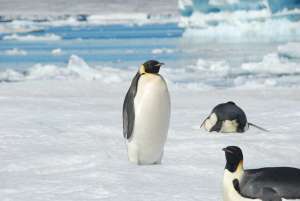
Adult emperor penguins can weigh between 20 and 45 kilos, and can exceed 120 cm in height. The blood samples were obtained from the birds’ feet through a procedure that lasted between four to five minutes, and ended with a small water-based dye mark on the penguins’ chests, which allowed the scientists to identify the species to be studied.

During the weeks that the research team was in the deep Antarctic, PhD. Juliana Vianna and PhD. Fabiola León, together with the support of Julieta Orlando Ph.D from University of Chile and Fabiola León Ph.D, were able to identify the species to be studied. Julieta Orlando from the University of Chile, and the logistic team of the French companies SEDNA Expeditions and Ponant, took samples of Adelie penguin (Pygoscelis adeliae), Antarctic tern (Sterna vittata) and Antarctic cormorant (Leucocarbo bransfieldensis) in the framework of the International Scientific Collaboration Expedition: Weddell Sea and Larsen B Ice Shelf, carried out by the Millennium Institute BASE and scientists from France, United Kingdom and United States at the beginning of this year.

Researchers from the Millennium Institute BASE in the field. Image: M. Institute BASE/ N. Politis

The polar researchers emphasize the importance of collaboration and interdiscipline, anticipating that during this year the penguins will continue to make news from Chile: “Between September 4 and 9 the entire scientific community will meet in Viña del Mar as we will hold the XI International Penguin Congress (https://www.penguin-conference.com), which still has some places available“, says PhD. Vianna.

The Millennium Institute of Biodiversity of Antarctic and Subantarctic Ecosystems, also known as Millennium Institute BASE, belongs to the Millennium Science Initiative, a program of the National Research and Development Agency (ANID), belonging to the Ministry of Science, Technology, Knowledge and Innovation of Chile. More information at institutobase.cl/en/


Photographs and text: Millennium Institute BASE

Aimed at undergraduate, master’s and doctoral students, this year the course has researchers from the Millennium Institute for Biodiversity of Antarctic and Subantarctic Ecosystems (BASE), and seeks to address different subjects related to Antarctic sciences.

April 20, 2023.- Since 2016, the Faculty of Natural and Oceanographic Sciences of the University of Concepción (UdeC) has the elective of Antarctic Ecosystems. This year, contents such as microbial ecology, biogeographic processes, conservation, governance, among others, will be taught by principal and affiliated researchers from the Millennium Institute BASE.

The first class of the elective, held on Thursday, April 13, was led by PhD. Angie Díaz, UdeC academic and main researcher at the Millennium Institute BASE, who introduced the students and presented the main guidelines of the course. She also addressed content related to the geological and climatic history of Antarctica (environmental conditions and glaciations) and the history and evolution of the Southern Ocean (Antarctic Circumpolar Current, water masses, and sea ice).

PhD. Angie Díaz explains that her motivation for taking this course was “to be able to show the science that is carried out in Antarctica from undergraduate level and approach it as a probable goal of study, particularly my area, which is the evolution of marine life in the southern ocean”. In addition, she adds that her objective has always been to “encourage Antarctic sciences, especially in the lines that the Millennium Institute BASE works in the different Universities, and encourage the interaction of researchers and students, among all the Institutions involved”.

PhD. Angie Díaz in the first class of the UdeC Antarctic Ecosystems course. Photo: I. Millennium BASE/M. sotomayor

In the next sessions, matters related to microbial ecology will be addressed; biochemical cycles and greenhouse gases; biogeographical processes in Antarctica and the Southern Ocean; the role of adaptation from a physiological perspective; biogeographic processes in terrestrial and marine biota; conservation, climate change and human impact; and Antarctic Treaty System (ATS).

For the first time, the main researchers from the Millennium Institute BASE will participate: academics from the University of Chile (Uch), PhD. Elie Poulin, PhD. Julieta Orlando and PhD. Luis Valentín Ferrada; the academics of the Austral University of Chile (UAch), PhD. Claudio González-Wevar and PhD. Luis Vargas Chacoff; the academic from the Pontificia Universidad Católica de Chile (UC), PhD. Juliana Vianna; the academic from the University of Magallanes, Dr. Tamara Contador; and the researcher from the Chilean Antarctic Institute (INACH), PhD. César Cárdenas. The academic body will also include the researcher attached to the Millennium Institute BASE, also from the Institute of Ecology and Biodiversity (IEB), PhD. Claudia Maturana.

This elective specialization course is carried out in a hybrid format and is counting on undergraduate, master’s and doctoral students from the UCh, UC, UACh, UMAG and Andrés Bello University (Unab). One of the big changes this year is the inclusion of Postgraduate programs, since previously it was focused only on undergraduate students.


By: Marcelo Sotomayor y Constanza Barrientos

Main picture: M. Institute BASE/ M. Sotomayor

With the aim of long-term monitoring of the biodiversity of the Southern Ocean, within the framework of the LIX Antarctic Scientific Expedition (ECA 59) of the Chilean Antarctic Institute (INACH), the Marine Observatory project of the BASE Millennium Institute was completed.

April 14, 2023.- With the installation of a Marine Observatory, the Millennium Biodiversity Institute of Antarctic and Sub-Antarctic Ecosystems (BASE) completed its scientific work in Antarctica during the 2022-2023 season in Fildes Bay. Using different sampling tools, it was sought to study the changes in the biodiversity of the Southern Ocean, monitoring that will continue to be developed in the coming years.

The team was led by the principal investigator of the Millennium Institute BASE , also from the University of Magallanes (UMAG) and the Cape Horn International Center (CHIC), PhD. Karin Gerard; and counted on the work of the academic of the University of Sorbonne and researcher of the Station Marine de Concarneau of the National Museum of Natural History of France, PhD. Cyril Gallut; the marine biologist from the Austral University of Chile (UACh) Vicente Villabolos; and the professional diver, Alberto Ahumada.

The Marine Observatory seeks to establish baselines of marine biodiversity, through different sampling methods: water filtration to obtain environmental DNA, the installation of an Autonomous Reef Monitoring Structure (ARMS), fishing trawling and autonomous diving. It is intended to cover a range of dimension and wide development, in order to monitor the dynamics of variation of marine diversity over ten years and see the effects of climate change.

Highlighting the impact of the scientific work carried out, PhD. Karin Gerard, also a researcher at the Laboratory of Antarctic and Sub-Antarctic Ecosystems (LmAS-UMAG), directed by PhD. Andrés Mansilla, explained that the environmental DNA obtained by the filtration of water from sea “allows detecting the presence of species without the need to collect them”, while with autonomous diving it is possible to reach organisms located up to 30 meters deep. On the other hand, “with the trawl you can get much deeper benthic macroorganisms, and with the ARMS facility, you can go as deep as 15 to 20 meters”, she said.

Marine Observatory Team at ECA59 of INACH. Image by PhD. Karin Gerard.

As indicated by PhD. Cyril Gallut, the ARMS were installed in the Ross Sea in Terra Nova Bay, and in the Dumont d’Urville Sea in the Pointe Géologie archipelago. “Thanks to an international collaboration we will be able to compare the biodiversity and settlement dynamics of benthic species at the level of the Southern Ocean,” he said.

ARMS are structures made of PVC plates that function as artificial reefs on which benthic flora and fauna settle. After one, two and three years, these ARMS will be removed to identify, by metabarcoding, the life that has developed in them. “Comparing different years we will be able to see the dynamics of recruitment of organisms”. They will be installed in two sites, Bahía Fildes and Yelcho, the first being more likely to receive exotic species due to intense maritime traffic”, explained the principal investigator of the BASE Millennium Institute.

Antarctica has a unique biodiversity on the planet that has been little studied. As we have grown as a society we have increased the risk of disrupting it and therefore losing it forever. The Marine Observatory installed by the Millennium Institute BASE and PhD. Gerard is crucial in avoiding this catastrophe, since it allows us to generate detailed information about the communities that inhabit this vulnerable region and move towards its conservation”, expressed the UACh researcher, Vicente Villalobos. .

“It is very important to have a baseline as soon as possible, to be able to see the changes. See which species arrive and which, in the short or medium term, manage to establish themselves in the marine environment. It is essential to have this Observatory and to continue monitoring it over time”, said the Director of the Millennium Institute BASE, Dr. Elie Poulin.

This project is part of the “Observatory” line of research of the Millennium Institute BASE, whose objective is to contribute to improving knowledge about biodiversity in Antarctic and Sub-Antarctic areas and to initiate long-term monitoring of biodiversity through marine areas and terrestrial ecosystems. to detect significant changes as a consequence of climate changes induced by human activity.


By: Constanza Barrientos

Main picture: César Cárdenas

A work carried out by researchers from the Millennium Institute BASE and the Microbial Ecology Laboratory (LEMi) of the University of Chile and which seeks to contribute to the description and conservation of the biodiversity of the ecosystems associated with lichens in the Aysén region and the Magellan region.

April 6, 2023.- The largest collection of basidiomycete yeasts isolated from the thallus of Peltigera lichens and the first collection of yeasts associated with lichens from southern Chile, was published in the Global Biodiversity Information Facility (GBIF) by researchers from the Millennium Institute BASE and the Microbial Ecology Laboratory (LEMi) of the University of Chile, guided by Dr. Julieta Orlando.

The initiative was led by Yosbany Pérez, a doctoral student from the University of Chile and also a researcher at LEMi and the Millennium Institute BASE, who pointed out that the work carried out “provided evidence that lichens would act as a specific niche that harbors different microorganisms, including yeasts. Those that are currently considered a new essential component of the symbiosis of lichens. This helps to provide more information about the components of the lichen mycobiome and, therefore, to enhance the conservation of these microorganisms and the ecosystems that surround them.”

The collection studied comprises 180 basidiomycete yeasts isolated and identified from the thallus of four Peltigera lichen species (P. frigida, P. fuscopraetextata, P. rufescens and P. antarctica) collected in southern Chile, specifically in the Coyhaique National Reserve and the Patagonia Natural Park, Tamango sector, located in the Aysén region of General Carlos Ibáñez del Campo; and in the Karukinka Natural Park and Navarino Island, located in the Magallanes and Chilean Antarctic region.

This study is the first to describe the presence of basidiomycete yeasts in Peltigera lichens. A great diversity of genera of basidiomycetes was found, belonging to the classes Agaricostilbomycetes, Cystobasidiomycetes, Microbotryomycetes and Tremellomycetes. The phylogenetic analyzes carried out suggest the presence of species not reported so far, requiring additional biochemical and physiological studies to describe these potential new species.

Basidiomycete yeast isolates. Image of Yosbany Pérez, doctoral student at the Millennium Institute BASE.

Some basidiomycete yeasts reported in association with lichens have a lifestyle completely dependent on them, so it is highly probable that the lichen species studied are reservoirs of unreported yeasts. The identification of these new yeast species could have future applications in research, for example, in the field of biotechnology.

“It is very important for the entire scientific community that there be free access to these data, so that any research team that needs the information can consult and use it. This platform (GBIF) allows anyone to access the database and be able to think about other investigations”, indicated the data manager of the Millennium Institute BASE, Catalina Marín, who worked with the team in the publication of the data.

For her part, PhD. Julieta Orlando, Alternate Director and principal investigator of the Millennium Institute BASE, stated that “we are committed to ensuring that the information we generate reaches various audiences, since we believe that knowledge of the biodiversity of Antarctic and sub-Antarctic environments it must not only reach decision makers, one of our fundamental objectives, but also other scientific teams and the community in general.”

“We are convinced that, through this transfer of knowledge, it will be possible to generate the necessary awareness to protect the biodiversity of these environments. In this sense, the publication of repositories of various organizations in GBIF is essential for us to make research data easy to find, accessible, interoperable and reusable (FAIR principles)”, added the director of LEMi.

The team was also made up of researchers from LEMi and the University of Chile: Nayla Serey, Natalia Lizana, Katerin Almendras and Juana Leal; and by the academic from the Department of Biology, Geology, Physics and Inorganic Chemistry of the Rey Juan Carlos University (Spain), Ana María Millanes.

Find the collection here https://doi.org/10.15468/hw7k9r

READ MORE>> Through the GBIF Chile platform, the Instituto Milenio BASE team promotes the democratization of data on biodiversity


Main picture: Peltigera lichens by M. Insitute BASE/ Julieta Orlando