

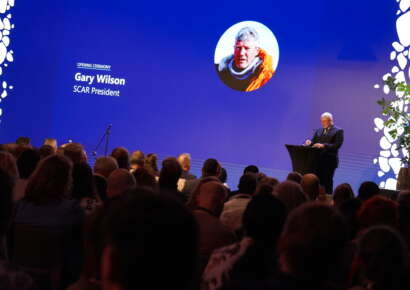
With a 16-member delegation, the BASE Millennium Institute is participating in the 12th SCAR Open Science Conference, one of the world’s leading international gatherings dedicated to Antarctic research. Scientists and professionals from the ANID Center of Excellence travelled to Oslo to share research findings, experiences, and recent advances in the study and communication of knowledge about the frozen continent.
Throughout August, Oslo becomes one of the world’s key meeting points for Antarctic research. The Norwegian capital welcomes experts from a wide range of countries and disciplines for a programme featuring nearly 50 scientific sessions, designed to share new knowledge and strengthen international collaboration on Antarctica and the Southern Ocean.
Once again, the BASE Millennium Institute is taking part in the 12th Open Science Conference of the Scientific Committee on Antarctic Research (SCAR), with a delegation that includes principal investigators Elie Poulin (U. de Chile), Karin Gérard (UMAG), Luis Valentín Ferrada (Derecho U. Chile), César Cárdenas (INACH), and Hugo Benítez (UNAB/CHIC), together with senior researchers Pete Convey (BAS) and Steven Chown (Monash University).
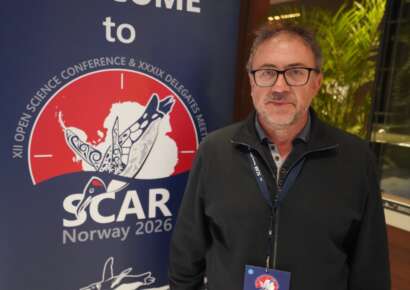
They are joined by a new generation of researchers who will present advances and findings from their work in Antarctic science. The group of early-career researchers includes Daly Noll (U. Lagos), Giovannina Sutherland (Derecho U. Chile/ICLAC), Jordan Hernández (UCM), Franco Cruz (Universidad Santo Tomás), Miguel Ángel Salazar (Universidad de Rennes), Albert Palomino (UACh), Eduardo Pizarro (PUC/CRG), and Morgane Durand (Muséum national d’Histoire naturelle, France).
“Participating in SCAR once again, with a diverse delegation, allows us to share the knowledge we are generating at the BASE Millennium Institute while strengthening our ties with an international scientific community that will be essential in addressing the challenges ahead. We are moving towards major milestones for polar science, including the upcoming International Polar Year 2032–2033, and gatherings like this are key to building new collaborations and developing new scientific questions from now on”, says Elie Poulin, director of the BASE Millennium Institute and professor at the Facultad de Ciencias, Universidad de Chile.
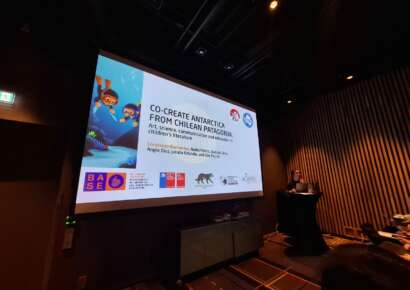
Representing the BASE Millennium Institute’s Communications and Education Office (DIRECOM), science journalist Constanza Barrientos is also part of the delegation, with three oral presentations and one poster. Her participation will showcase Antarctic science communication initiatives developed by the Institute to bring polar knowledge closer to a wide range of audiences.
The presentations by Barrientos, who also leads as president of the Fundación Coalición Jóvenes Antárticos de Chile, based in Punta Arenas, will explore experiences in children’s literature, Antarctic education, artificial intelligence, and new technologies, highlighting how different forms of communication, formats, and tools can help broaden the social reach of knowledge generated about Antarctica.
By: Nadia Politis
Photos by: Constanza Barrientos, from Oslo, Norway


