As part of its participation in the 61st Antarctic Scientific Expedition (ECA61) of INACH, the team from the UC Molecular Biodiversity Laboratory, led by Dr. Juliana Vianna, crossed the Antarctic Circle to enhance the surveillance and monitoring of Highly Pathogenic Avian Influenza (H5N1) in the frozen continent.

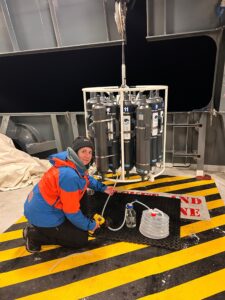
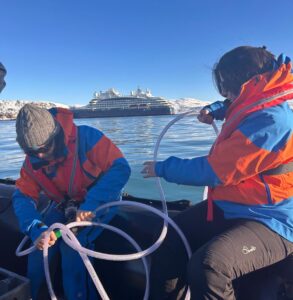
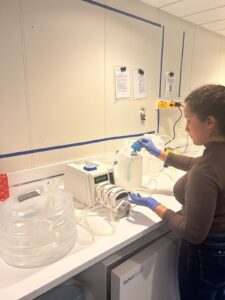
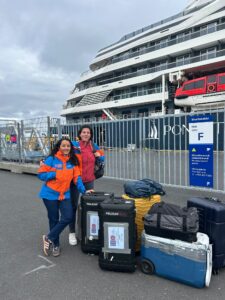
Punta Arenas.—Under strict biosecurity measures and in coordination with the Chilean Antarctic Institute (INACH), the Chilean Navy, Army, and Air Force, scientists Dr. Fabiola León, Claudia Ulloa, and Carolina Márquez embarked on their scientific journey aboard the Betanzos vessel, operated by DAP. Their mission is to collect samples and conduct laboratory analyses as part of their work at the UC Molecular Biodiversity Laboratory, led by Dr. Juliana Vianna (BASE/CRG, Lili, UC Institute for Sustainable Development), in collaboration with the Millennium Institute BASE.

“After successfully detecting positive cases of Highly Pathogenic Avian Influenza (H5N1) in Antarctica during the ECA60 expedition of INACH in January 2024, we have been working diligently to analyze samples and coordinate research teams studying birds such as penguins, cormorants, and skuas in Antarctica,” says Dr. Juliana Vianna, a Ph.D. in Biological Sciences with a specialization in Ecology and a faculty member at UC.

The Antarctic scientist, who also serves as the deputy director of the Millennium Institute CRG, highlights the importance of studying wildlife health in Antarctica due to the connectivity between species and the continent’s crucial role in global ecosystem balance. “The migration and movement of species can influence the spread of avian influenza, potentially increasing mortality rates. This underscores the importance of continuing field studies to monitor affected areas and species,” emphasizes Dr. Vianna.

The scientific work with birds in Antarctica aims to strengthen the surveillance and monitoring of Highly Pathogenic Avian Influenza (H5N1).

Throughout 2023-2024, the collection and analysis of samples in Antarctica were coordinated by researchers Dr. Fabiola León (UC/BASE/CRG, Lili) and Eduardo Pizarro (UC/BASE/CRG), with international support from the vessel Le Commandant Charcot, operated by Ponant Cruises. In 2025, the research is being conducted aboard the Betanzos vessel, part of the DAP group, reaching beyond the Antarctic Circle into the so-called “deep Antarctica,” specifically in Lagotellerie Island and Aves Island in Margarita Bay.

“Our field experience has been essential in ensuring safe and rigorous scientific work under strict biosecurity measures. It is important to highlight that our campaigns cover a wide geographic range and are conducted at different times of the season, allowing for surveillance over a timeline that helps determine the status of avian influenza at various stages of the nesting season for both flying and non-flying birds,” says Dr. Fabiola León. Her research has taken her to sample emperor, Adélie, gentoo, and king penguins in locations such as Snow Hill Island, Danger Islands, Red Rock Ridge, Cape Hallett, and Sims Island.

Essential biosecurity measures

The “Prevention and Control Protocol for Highly Pathogenic Avian Influenza (HPAI) in Antarctica,” issued by the Chilean Antarctic Institute (INACH), aligns with international recommendations from the Scientific Committee on Antarctic Research (SCAR). These biosecurity measures apply to all expeditions taking place from January to March 2025 in Antarctica and follow the “One Health” guidelines for preserving the health of the unique and fragile Antarctic ecosystem.

“The study of avian influenza and its evolution is essential for understanding viral dynamics and global public health. At our Millennium Institute BASE, we are committed to scientific excellence, working rigorously and collaboratively to address this constantly evolving phenomenon. High-quality science not only allows us to obtain accurate results but also provides the necessary tools to anticipate and mitigate risks associated with the spread of infectious diseases,” states Dr. Elie Poulin, director of the Millennium Institute for Antarctic and Sub-Antarctic Ecosystem Biodiversity.

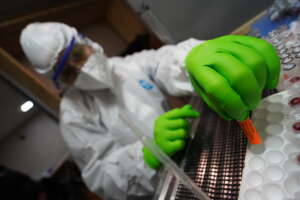
As part of these protective efforts, Personal Protective Equipment (PPE) plays a crucial role. As indicated by the Chilean Institute of Public Health (ISP), PPE includes specialized gear, apparatus, or devices designed to protect the body—either partially or entirely—from specific risks. These measures help prevent occupational diseases, reduce accidents, and minimize their impacts.

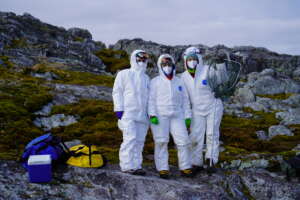
Researchers Fabiola León, Claudia Ulloa, and Carolina Márquez wear biosecurity suits for sample collection in Antarctica.

The Millennium Institute BASE/UC/CRG research team emphasizes that in Antarctica, the use of masks, gloves, and coveralls protects both people and the living organisms inhabiting the region. “Introducing new pathogens from humans to birds and mammals or unintentionally transporting and spreading them from healthy colonies to other locations is a critical concern that requires extreme caution,” they note. Additionally, pre- and post-sampling cleaning of equipment before entering any area is a mandatory part of the daily protocol during field expeditions.

“Highly pathogenic avian influenza is a major concern within the international scientific community,” states Dr. Ricardo Jaña, head of INACH’s Scientific Department. “A special group has been organized to gather and analyze evidence across different Antarctic research sites, establishing an information system through reports,” he adds.

Jaña highlights that this effort extends beyond Chile, as other countries are also contributing data from their research expeditions. “South Korea has recently reported findings in the Fildes Peninsula area, and Chile, through its campaign in Margarita Bay, has also documented cases from different bird populations,” he notes.

INACH’s Scientific Department head and expert in Natural Resources/Glaciology affirms that “this concern extends beyond Antarctica.” “In the local region, a working group led by the Ministry of Agriculture has been established, with our colleague Marcelo González serving as an institutional representative,” he concludes.

Through tools such as infographics and specialized publications, the Chilean Antarctic Institute has provided guidelines and recommendations, which can be downloaded from https://www.inach.cl/expedicion-antartica/protocolo-influenza-aviar/.

Blood Sample Analysis in Penguins Helps Study Highly Pathogenic Avian Influenza (H5N1)

The early detection and epidemiological surveillance of highly pathogenic avian influenza (HPAI) in the Antarctic Peninsula are being led by various virology and wildlife teams from the Chilean Antarctic Institute’s National Antarctic Science Program (PROCIEN). Since 2024, two avian influenza testing laboratories have been operating at Escudero Base and O’Higgins Base to support areas of national and international interest and establish connections with the Scientific Committee on Antarctic Research (SCAR) programs.

This initiative is complemented by Antarctic governance actions, where Chile is leading an intersessional contact group under the Antarctic Treaty on Highly Pathogenic Avian Influenza. This group includes, for example, Dr. Luis Valentín Ferrada, a professor at the University of Chile and researcher at the Millennium Institute BASE.

A joint effort between universities, top-tier research institutes, and Antarctic operators underscores the significance of collaborative work and scientific research in Antarctica to understand and mitigate the risks associated with avian diseases in this unique region.


By: Nadia Politis
Photographs: Constanza Barrientos/Millennium Institute BASE

Aboard the French research vessel Le Soléal (Ponant Cruises) collaborative effort between PhD. Claudio González-Wevar (UACh/BASE/IDEAL) and Professor Hamish G. Spencer (University of Otago) combines expertise in molecular genomics, evolutionary biology, and biogeography to investigate the distribution, diversity, and evolutionary history of molluscs in the Southern Ocean’s unique and understudied ecosystems. The expedition aims to advance the understanding of subantarctic molluscs through detailed collection and study.

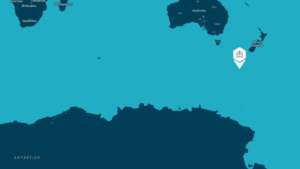
Marking their tenth expedition, the BASE Millennium Institute and Ponant Cruises continue groundbreaking research, this time on Macquarie, Stewart and Auckland Islands, led by PhD. González-Wevar, head of the Laboratory of Antarctic and Subantarctic Molecular Genomics and Ecology (LAGEMAS-UACh). The project is also strengthened by the expertise of Professor Hamish G. Spencer, Sesquicentennial Distinguished Professor from the Department of Zoology at the University of Otago, New Zealand. Together, the team focuses on sampling and analyzing intertidal ecosystems, highlighting the importance of these islands, which host key study groups such as mollusc species Nacella (e.g., terroris, macquariensis), Laevilitorina (e.g., mcphersonae, venusta), and Margarella (e.g., violacea, macquariensis), among others.

The scientific work involves sampling from the subantarctic intertidal zone. Image: Hamish Spencer

“The participation of PhD. Hamish Spencer from the University of Otago has been invaluable. His expertise enabled us to access Stewart Island and collect specimens for our studies”, González-Wevar adds. The expedition covers rare and remote locations, including Traills Bay, the Auckland Islands in New Zealand, and Macquarie Island in Australia. These areas offer unparalleled opportunities for understanding biodiversity and ecological dynamics.

Professor Hamish G. Spencer, underscores the significance of the research: “The biogeography of the Southern Ocean is fascinating and yet understudied. Nevertheless, we have long understood that the world’s strongest oceanic current, the Antarctic Circumpolar Current (ACC), is the major physical player in the distribution of organisms in the subantarctic. In a long-standing collaboration with Professor Claudio González-Wevar of BASE, I am interested in understanding how long-distance dispersal in the ACC has shaped the marine biodiversity around the shores of the Southern Ocean. We have used molluscs as our model organisms and have previously collaborated on projects about limpets (Nacella and Siphonaria), topshells (Margarella), and periwinkles (Laevilacunaria and Laevilitorina)”.

Spencer elaborates on the mission’s goals: “We now want to expand our work to include more populations and species from the New Zealand and Australian subantarctic islands (Auckland, Campbell and Macquarie). These islands are especially important because they have acted as refugia for some species during past Ice Ages. We are aiming on this cruise to collect samples of all of the above genera, as well as some others for new projects (e.g., the bivalve Gaimardia). Our preliminary work on some of these groups suggests that there has been significant evolutionary radiation in this region, even though it is connected by long-distance dispersal to Patagonia, the Antarctic Peninsula, and the subantarctic islands in the Atlantic and Indian sectors”.

The Auckland and Campbell Islands (New Zealand) and Macquarie Island (Australia) are key sites for scientific research.


A Partnership Driving Scientific Excellence

Since 2022, the collaboration between the BASE Millennium Institute and Ponant Cruises has paved the way for groundbreaking research. “This partnership allows us to conduct more and better science while strengthening ties with world-class research teams”, says PhD. Elie Poulin, director of the BASE Millennium Institute.

PhD. Claudio González-Wevar and Phd. Hamish Spencer embarking on a subantarctic expedition.
Image: C. González-Wevar

Together with Dr. Spencer, González-Wevar delves into population genetics, phenotypic plasticity, phylogenetics, and the unique characteristics of New Zealand molluscs. The Auckland, Campbell, and Macquarie Islands are pivotal to their work, particularly Macquarie Island, which UNESCO declared a World Heritage site in 1997. This island’s geological significance, as the only location where mantle rocks are exposed above sea level, underscores its importance for scientific inquiry.

Professor Spencer concludes: “The ultimate goal of our work is to explain the origin of intertidal and nearshore Southern Ocean biodiversity, especially the range of evolutionary outcomes, from widespread species to island-group endemics”.

UNESCO highlights New Zealand’s subantarctic islands as biodiversity hotspots where Antarctic and subtropical waters converge, fostering high marine productivity and unique ecosystems. “These islands boast significant endemism, especially among birds, plants, and invertebrates”, the organization points. This biodiversity underscores the global significance of research conducted by González-Wevar and his team.


By: Nadia Politis, BASE Millennium Institute

Main picture: French vessel Le Soléal, operated by Ponant Cruises. By Hamish Spencer.

The Institute of Biodiversity of Antarctic and Subantarctic Ecosystems calls for a public competition for a postdoctoral position in Environmental DNA, Metabarcoding and Metagenomics for biodiversity research in Antarctic and sub-Antarctic areas. Chileans or foreigners may apply. The postdoctoral fellow will join the research team “Biodiversity Observatory”, along with providing transversal support to the research of other groups of the institute. The place of performance is preferably in Punta Arenas, Region of Magallanes and Chilean Antarctica.

This line of research seeks to improve knowledge of Antarctic and sub-Antarctic biodiversity through the characterization and monitoring of marine and terrestrial ecosystems to detect significant changes in macro and microorganism communities because of anthropogenic climate change, using advanced technologies such as environmental DNA analysis (eDNA), metabarcoding and metagenomics.

The researcher will design, develop, and implement bioinformatics workflows to process and analyze massive sequencing data, with special emphasis on metabarcoding and metagenomics methodologies. The researcher will participate in the study of samples previously available in the laboratory and in obtaining new samples through field expeditions. The requirements are to have the academic degree of PhD in accredited national programs or their foreign equivalents, in disciplines related to the required profile: ecology, evolutionary biology, microbiology, or related disciplines, and availability to start working preferably from May 2025.

The documents to be submitted for the application are:

  • Doctorate degree certificate (a simple photocopy is accepted for application, the selected applicants will be asked for the original documents or certificates).
  • Curriculum vitae, highlighting the research carried out, through participation in research projects and published or accepted articles. Include bibliometric indicators such as H index. In addition, include a link to a personal academic portal such as ORCID and/or Google Scholar.
  • A letter of intent
  • Two letters of recommendation

In the event that the selected researcher is a foreign national, he/she must prove residence in the country through a permanent or temporary residence visa or a document that proves the application for a permanent visa with work authorization at the start date of the project. It is also possible to consider a student visa with work authorization. To do so, they must send the document that accredits it and a valid identity card for foreigners. If the selected researcher has a temporary visa, he/she must send the document that accredits him/her and a valid identity card for foreigners. If he/she has permanent residence, he/she must submit the latter document. In qualified cases, the relevance of other visas will be analyzed. The processing of the contract will be subject to the presentation of the aforementioned documents.

Bases and information regarding this competition are available at this link as of January 2025. The submission of background information must be made through the e-mail administracion@institutobase.cl and the deadline is March 31, 2025. The final decision regarding the award of the postdoctoral positions will be made by the Council of Principal Investigators of the ICN2021_002 project, during April 2025.


The capital of the Los Ríos region becomes a crucial place for researching the resistance of Antarctic fish to hypoxia induced by climate change. Alaska researcher PhD. Kristin O’Brien and chilean researcher PhD. Luis Vargas-Chacoff are collaborating to find conservation responses and strategies to this challenge.

PhD. Kristin O’Brien University of Alaska Fairbanks (UAF). Photo: BASE Millennium Institute / A. Bertrand.

With 25 years of experience in Antarctic science, PhD. Kristin O’Brien, professor of biology at the University of Alaska Fairbanks (UAF), arrived in the city of Valdivia – located in the Los Ríos region, Chile – to work with the researcher from the Faculty of Sciences of the University Austral of Chile (UACh), BASE Millennium Institute and IDEAL Center. PhD. Luis Vargas Chacoff. The aim is to study the ability of Antarctic notothenioid fish and their ancestor, Eleginops maclovinus – also known as snook – to cope with hypoxia generated by climate change.

As temperatures rise, the oxygen level in the oceans decreases, and hypoxic events are becoming more frequent and severe in the world’s oceans. To understand how this phenomenon affects them, the research team has focused their attention on the snook, a species located in the Los Ríos region, and which is the closest ancestor to the most abundant group of fish in the Southern Ocean surrounding the frozen continent: the notothenioids.

“To accurately predict the impacts of climate change on Antarctic fish, it is important to understand the ability of their ancestor, E. maclovinus, to cope with climate change. In addition, because this fish has never inhabited the icy waters of the Southern Ocean, by comparing its biology to its Antarctic relatives, we can identify the traits that allowed Antarctic fish to adapt and thrive in their frigid environment”, explains PhD. Kristin O’Brien.

PhD. Luis Vargas-Chacoff and PhD. Kristin O’Brien working at Calfuco Coastal Laboratory UACh. By: BASE Millennium Institute / A. Bertrand.

Through experiments, the team is measuring the minimum amount of oxygen that these fish require to survive, as well as their physiological and biochemical ability to adapt. The research results are expected to show the ability of these animals to resist lack of oxygen as the ocean warms and may reveal new mechanisms to control hypoxia.

“We have different knowledge that complements each other. I highly value PhD. Vargas-Chacoff’s expertise in stress physiology, osmoregulation, and the immune system of fish. It brings to the project knowledge and experience that the other members of the group do not have so that we can better understand the ability of these animals to resist climate change”, says PhD. Kristin O’Brien, who is  also affiliated with the Institute of Arctic Biology at UAF.

PhD. Kristin O’Brien’s visit included the collection of samples and work at the Calfuco Coastal Laboratory, belonging to the Faculty of Sciences of the UACh. “I am tremendously grateful to PhD. Vargas-Chacoff, the Calfuco Coastal Laboratory and UACh for this opportunity to work with them. Daniela Nualart (PhD student in Aquaculture Sciences, BASE Millennium Institute scholarship) and Francisco Dann have been tremendously helpful and important members of our team while working here. We could not have completed our research without them”, she says.

Research team at Calfuco Coastal Laboratory UACh. By: BASE Millennium Institute / A. Bertrand.

For his part, the Doctor of Sciences, Luis Vargas-Chacoff, recently appointed director of the Graduate School of the UACh Faculty of Sciences, states that “the collaboration with PhD. O’Brien and her team is essential to understand how climate change affects Antarctic fish. Our combined knowledge will allow us to gain a more complete understanding. I am grateful for this opportunity to collaborate on such a crucial project for Antarctic science”.

“As a local researcher, I greatly value the opportunity to contribute to this work. Antarctic science is not only carried out in Antarctica itself; it is vital to recognize that regions such as Valdivia play a fundamental role in this field, being able to contribute with scientific and physiological knowledge of different biological models or native species that can be affected by global climate change”, adds the UACh doctoral student, BASE Millennium Institute and IDEAL Center, Daniela Nualart.

The project is funded primarily by the National Science Foundation (NSF) and also features UAF graduate student Augustus Snyder and PhD. Yangfan Zhang of Harvard University.


By: Constanza Barrientos Soto

Main image: Research team at Calfuco Coastal Laboratory UACh. By: BASE Millennium Institute / Antonia Bertrand


The project led by the BASE Millennium Institute of Chile and the University of Burgundy of Dijon, France, seeks to establish a coastal observation network to identify exotic species present in marine ecosystems and promote international collaboration and knowledge exchange.

Patagonia, Kerguelen islands and the Antarctic peninsula are the regions whose coasts will be monitored by the project led by PhD. Elie Poulin, from the BASE Millennium Institute, and PhD. Thomas Saucède from the University of Burgundy. An initiative financed by the National Research and Development Agency (ANID) and the Evaluation and Guidance Committee of Scientific Cooperation with Chile of the Government of France (ECOS).

The project, which lasts three years (2023-2025), aims to establish an observing network for detection of exotic subantarctic and Antarctic species and monitor marine biodiversity using Autonomous Reef Monitoring Structures (ARMS), through the metabarcoding technique. This molecular technique allows the identification and quantification of species in water and sediment samples based on the DNA present in them.

The director of the BASE Millennium Institute and academic at the University of Chile (UCh), PhD. Elie Poulin, points out that “these species, introduced by human activities in non-native ecosystems, can have negative consequences on biodiversity and pristine ecosystems. The initiative seeks to improve understanding of the presence and potential impacts of these species through extensive monitoring in key areas. The project hypothesis states that many of these exotic species do not survive underwater winter temperatures, which keeps them unknown in conventional biodiversity records”.

The ECOS-ANID project “Monitoring of subantarctic alien species in Antarctic Peninsula: setting-up a network of nearshore observing systems in Patagonia, Kerguelen and Antarctica”, has a team of professionals from different regions of Chile and France. From the BASE Millennium Institute: PhD. Karin Gerard (University of Magallanes CIGA UMAG, CHIC, LEMAS), PhD. Angie Díaz Lorca (University of Concepción), Carolina Pérez Troncoso (master’s student at the University of Magallanes), Sebastián Rosenfeld (doctoral student at the University of Chile, CHIC, Apecs Chile) and Erwan Courville (University of Burgundy), From the Sorbonne University, with PhD. Cyrill Gallut.

International collaboration and knowledge exchange

PhD. Thomas Saucède has been collaborating for more than ten years with researchers from the BASE Millennium Institute, in biogeography and phylogeography of marine invertebrates (mollusks, echinoids and fish). Regarding the current project, he points out that “it is a good opportunity to continue collaborating based on our good complementarity in terms of access to the field and to samples throughout the Southern Ocean”.

“It allows us to unite and collaborate in areas such as Patagonia and Antarctica, on the part of the Millennium BASE Institute, and in the subantarctic archipelagos of Crozet and Kerguelen, on my part. “We also complement each other in terms of methodology (genetics, genomics, morphology, taxonomy, biogeography, paleontology) to address important questions related to the origin, evolution and sensitivity of marine species to climate changes at the scale of the Southern Ocean in a comprehensive manner”, he adds.

From left to right: Ewan Courville, PhD. Thomas Saucède and PhD. Elie Poulin. Photo: BASE Millennium Institute / Carolina Gajardo

During March 2024, PhD. Thomas Saucède spent two weeks in PhD. Elie Poulin’s laboratory at the UCh, working alongside the doctoral student, Erwan Courville, who develops his thesis under co-tutorship with both researchers. Erwan is doing a phylogenetic and biogeographic study of the sea urchin genus Arbacia.

“This mobility program gives us the opportunity to co-tutor and train master’s and doctoral students between Chile and France in molecular ecology. Erwan Courville is currently completing a comprehensive phylogenetic and biogeographic study of the echinoid genus Arbacia, including the southern species. “We are working on publishing his results and completing his doctoral thesis”, says the Burgundy University academic.


By: Carolina Gajardo y Constanza Barrientos

Main image: Karin Gerard


The vacancy is available for chileans and foreigners with an academic degree of Doctor in accredited national programs or their foreign equivalents, in disciplines relevant to the required profile. Applications will be open until April 30, 2024.

The Biodiversity Institute of Antarctic and Subantarctic Ecosystems (BASE) seeks to provide a postdoctoral scientific position in Niche Models or Species Distribution Models (SDMs), a call to which Chileans or foreigners can participate to carry out research within the framework of Project ICN2021_002.

Looking for a person, preferably in regions, for biodiversity research in Antarctic and subantarctic areas, with management of software in the field of Geographic Information Systems, preferably ArcGis. In addition, with medium-advanced knowledge of the R language, knowledge of modeling packages and script development.

The submission of background information must be made through the email administracion@institutobase.cl and the deadline expires on April 30, 2024. The final resolution regarding the award of postdoctoral positions will be made by the Council of Principal Researchers of the project in May 2024.

For more details about the contest, review the rules:

PDF bases in English.

PDF Bases in Spanish.

Main image:  BASE Millennium Institute / Pablo Guerrero

Punta Arenas, March 2024.- Earlier this week, Chile announced the detection of positive cases of Highly Pathogenic Avian Influenza (H5N1) in Antarctica, during the LX Antarctic Scientific Expedition (ECA 60) organized by the Institute Chilean Antarctic (INACH).

BASE Millennium Institute team in Antarctica, monitoring penguin colony. Photo: StudioPONANT / Morgane Monneret

For the first time, positive cases of avian flu have been detected in Adelie penguins (Pygoscelis adeliae) and Antarctic shags (Leucocarbo bransfieldensis), marking a milestone in research into the health of wildlife in this territory. This discovery was made by the Millennium Biodiversity Institute of Antarctic and Subantarctic Ecosystems (BASE Millennium Institute) in collaboration with the french company PONANT, with the participation of an international research team led by PhD. Elie Poulin (Universidad de Chile, BASE Millennium Institute) and PhD. Juliana Vianna (Pontificia Universidad Católica de Chile, BASE Millennium Institute and CGR, Lili, Institute for Sustainable Development UC), in collaboration with PhD. Céline LeBohec, from CNRS, France, and CSM, Monaco, and the Oceanographic Institute of the Albert I Prince of Monaco Foundation (IOM).

The samples were obtained at thirteen breeding sites along the Antarctic Peninsula and the western coast of the White Continent, with international support from the ship Le Commandant Charcot. Following a highly sensitive PCR analysis carried out by PhD. Fabiola León (BASE Millennium Institute, Pontificia Universidad Católica de Chile, CRG, Lili), nine cases of highly pathogenic avian influenza (H5N1) were detected in penguins and shags, being the first records of these two species in Antarctica.

Adding to this epidemiological surveillance effort is what was carried out near the Czech Johann Gregor Mendel base on James Ross Island by national researchers. An unusual mortality of skuas was reported here in early March, which alerted the team of virologists from the National Antarctic Science Program (Procien) at the Professor Julio Escudero base at INACH. This equipment was transferred aboard the Chilean Navy ship Janequeo to carry out the corresponding sampling. This tuesday, it was finally confirmed that the samples collected returned a positive result for the avian flu virus.

Aerial view of the ship Le Commandant Charcot of the Ponant company. Photo: Ponant

These analyzes are part of the INACH collaborative project “Identification and Characterization of HPAIV H5N1 in Antarctica”, led by PhD. Marcelo González, head of the INACH Scientific Department. The tests were processed at the Escudero base by veterinary doctors specialized in molecular diagnosis, headed by PhD. Víctor Neira, from the Animal Virology Laboratory (FAVET) of the Universidad de Chile.

Since the beginning of monitoring the highly pathogenic avian influenza virus in birds in Antarctica, the Scientific Committee for Antarctic Research (SCAR) has developed a project to monitor the virus in the antarctic and subantarctic territories, a work that is being carried out continuously and systematically from Chile. These findings highlight the importance of collaborative work and scientific research in Antarctica to understand and mitigate the risks associated with avian diseases in the region.


By: INACH and BASE Millennium Institute

Main image: Ponant

The alternate director of the Millennium BASE Institute, Julieta Orlando, emphasized the significance of the white continent for the planet, during a keynote talk organized by the Center for Research and Advanced Studies of the Universidad Católica del Maule.

BASE Millenium Institute associate researcher, PhD. Hugo Benítez, and alternate director of the BASE Millennium Institute, PhD. Julieta Orlando. Photo: BASE Millennium I.

“Protecting Antarctic biodiversity is important for humanity”. With this statement, the alternate director of the Millennium BASE Institute, Julieta Orlando, emphasized why the frozen continent is considered the heart of the planet, during a master lecture she gave at the Universidad Católica del Maule (UCM).

“While Antarc tica looks remote and isolated, it is very interconnected. What happens there can affect other latitudes, including permanent human settlements, and therefore the protection of that biodiversity not only takes care of that balance, but also the global one”, said the associate professor of the University of Chile in the activity organized by the Center for Research and Advanced Studies of Maule (CIEAM, in Spanish), belonging to the campus.

The event, which was attended by the dean of the Faculty of Agricultural and Forestry Sciences of the institution, Claudio Fredes, was aimed at commemorating Antarctica Month.

CIEAM Researcher, PhD. Alexis Castillo. Photo: Universidad Católica del Maule

“It is also important to maintain the balance in this territory because there are many resources within the biodiversity that are not yet known but could prove useful in the future”, stated the PhD of Sciences, who has made several contributions to polar research, considers both charismatic and well-known organisms, as well as imperceptible microorganisms that could mitigate climate change.

The scientist has participated in ten expeditions to the southernmost continent in the world, which celebrates its day every November 6, commemorating the milestone established by former President Pedro Aguirre Cerda when he defined the limits of the Chilean Antarctic Territory in 1940.

PhD. Julieta Orlando, alternate director of the BASE Millennium Institute. Photo: BASE Millennium I. / N. Politis

“The Chilean Antarctic Institute, INACH, envisions Antarctica being recognized not just on a specific day, but throughout a whole month, so that all people, even from Arica, Iquique or Antofagasta, can feel that this territory is an integral part of their country and the planet”, she emphasized.

In addition to Orlando, doctors Aparna Banerjee, Alexis Castillo and Felipe Gordillo, as well as the director of CIEAM and researcher at the Millennium BASE Institute, PhD. Hugo Benítez, shared their experiences on the white continent.

“The center has two Antarctic science projects that were awarded two years ago. With this event, we aimed to showcase our high-level research in the Antarctic environment, and invite students to participate of it with internships and doctoral or master’s theses”, said Benítez.

Click here to visit the CIEAM Website

By: Universidad Católica del Maule

Main picture: BASE Millennium I. / N. Politis


“I came to Chile for an exchange with the Catholic University of Chile (UC), I wanted to live in a country with research networks in Antarctic science. When I arrived, I sent an email to the Association of Polar Early Career Scientists (APECS) of Chile and to my Edinburgh professors with contacts here, looking for an opportunity to get involved with the Antarctic scientific community from APECS Chile, they offered me to visit the Molecular Ecology Laboratory of the University of Chile (Uch).

Emily Gschwind with the doctoral researcher of the BASE Millennium Institute, Sebastián . Photo: BASE Millennium I. / N. Politis.

My name is Emily Gschwind, I am from Germany, but I am studying marine biology at the University of Edinburgh in Scotland, and that is where I first learned about APECS. Antarctica always caught my attention, so when I was in my first year of college and I met one of my professors, who researches microflora in Antarctica, I asked him about opportunities for ecology students and he told me about APECS.

In this exchange I learned a lot, it was the first time I was so far from home, from my family and friends. Arriving without knowing anyone and with a low level of spanish was the most difficult thing I’ve ever done, but also, thanks to it, I was able to learn and grow. I learned to speak spanish, I met friends who were my second family, I learned to adapt to new places and situations, and I was able to travel and get to know Chile, one of the most beautiful and diverse countries in the world. I was also able to explore new interests, such as rock climbing, salsa dancing, and cooking.

I loved living in Santiago, what I liked the most were the new opportunities that the city offers, from culture and history and social movements, to the mountains and the incredible nature that is around. In Santiago there are always new things to explore. Being a mountaineer, I took advantage of how close the mountain range is to the city, and went hiking almost every weekend. I am from Berlin, a very flat place, so the part of living in Santiago that I liked the most was the opportunity to climb hills so frequently.

Emily Gschwind. Photo: BASE Millennium I. / N. Politis.

This experience has motivated me to link my scientific career with Antarctica more than ever, I have always been interested in Antarctic science, and this experience made my dream of working in it a real possibility for me. I am sure that I want to continue with this type of research (marine ecology) in the future, and especially on the white continent. Thanks to this experience I have seen the importance of Antarctic research, and also the great variety of topics that are studied and everything that this work means.

At first I was a little nervous, because it was my first marine biology internship, and my first experience working in a laboratory, but working with Sebastián Rosenfeld and PhD. Elie Poulin has been a great experience. I am very grateful to them for helping me, teaching me and making me feel welcome in the team. I learned a lot and gained a lot of confidence.

Now I plan my scientific career doing ecological research in Antarctica, working in the field. But in the near future, I’m going to finish my final year of undergraduate first, and then I see myself pursuing a master’s and then a PhD in marine ecology, but I’m not sure yet specifically. I would like to do more internships and further explore my interests in marine ecology before deciding. Hopefully in one of these steps I can return to Chile!

By: Emily Gschwind

Emily Gschwind is an undergraduate student at the University of Edinburgh in Scotland and carried out taxonomic identification of shallow molluscs from the Weddell Sea, South Georgia Island and the Falkland/Malvinas islands, within the framework of conducting biodiversity inventories promoted by the BASE Millennium Institute supported by the doctoral researcher and specialist in molluscs PhD. (c) Sebastián Rosenfeld and by the director of the Molecular Ecology Laboratory of the University of Chil, also director of the BASE Millennium Institute, PhD. Elie Poulin.

Main photo: BASE Millennium I. / N. Politis

From October 24 to 26, 2023, more than a hundred scientific teams will meet at the Teaching and Research Assistance Center of the University of Magallanes (CADI-UMAG). Human footprints in Antarctica, biotechnology, climate change and international Antarctic law are part of the event’s themes.

Punta Arenas, June 2, 2023.- With the motto “Interdiscipline, Science and Future Scenarios”, researchers from all over Chile will meet from October 24 to 26 in Punta Arenas to exchange their advances in polar science and their challenges for the next years.

The eleventh version of the Chilean Congress of Antarctic Research, which after 19 years is once again taking place in this southern city, will also include tables on Antarctic Scientific Communication, Women in Antarctic Science and a keynote talk open to the public. In this way, the most important meeting of Chilean polar knowledge recovers its face-to-face character after the COVID-19 pandemic forced the previous version to be done virtually in 2021.

The State of the Antarctic ecosystem; Antarctic Thresholds: Ecosystem Resilience and Adaptation; Climate change in Antarctica; Astronomy and Earth Sciences; Biotechnology; Human footprints in Antarctica, and Social Sciences and Humanities are the lines of study that converge in the National Antarctic Science Program, administered by the Chilean Antarctic Institute (INACH), with the aim of developing areas of particular national and international interest and establishing links to the Scientific Committee on Antarctic Research (SCAR) programmes. In the same way, it guides the financing priorities of the competitive funds. All this universe of topics and interested parties will meet in the city that is the gateway to the White Continent.

The XI Chilean Congress of Antarctic Research is organized by INACH, the Millennium Biodiversity Institute of Antarctic and Subantarctic Ecosystems (BASE Millennium Institute) and the Scientific Committee for Antarctic Research. Registration can be done on the site https://www.inach.cl/xicongresoantartico/ .

In parallel, the “V Chilean Conference on Antarctic Law: Relationship between the Antarctic Treaty System and other international regimes” will be held, promoting multi and interdisciplinarity in polar studies. The meeting will take place on October 24 and 25, in a hybrid manner. Papers and articles will be received that, preferably, address political-legal issues regarding the relationship between the Antarctic Treaty System and the other international regimes that eventually apply or may apply in the Sixth Continent or in the Southern Ocean, such as the Agreement on the Conservation of Biodiversity beyond the Areas of National Jurisdiction (BBNJ) or the United Nations Convention on the Law of the Sea (UNCLOS), among others. Abstract submission is available until August 18.