The new partnership will seek to strengthen the dissemination of content on Antarctic and subantarctic research produced by the BASE Millennium Institute through the editorial’s lens, bringing excellent research closer to different groups of readers in Chile and around the world.
The recent collaboration agreement signed with Editorial SurCiencia represents a new stage for the science outreach developed by the BASE Millennium Institute. Among its priorities is the publication of works aimed at diverse audiences, with education as a central tool for knowledge. “This partnership seeks to give sustainability to the science outreach books we are able to develop, making it possible to expand their reach and presence throughout the country, as well as the development of new stories around Antarctic and subantarctic research aimed at different audiences,” says Dr. Elie Poulin, faculty member at the University of Chile and director of the BASE Millennium Institute.
“We believe that science outreach gains greater value when books succeed in meeting their readers. This agreement will allow us to work with the BASE Millennium Institute to develop publications that bring Antarctic and subantarctic research closer to children, families and educational communities, favouring a broad and sustained circulation of this content,” underlines Fresia Grimberg, editor and representative of Editorial SurCiencia.
Antarctica in early childhood
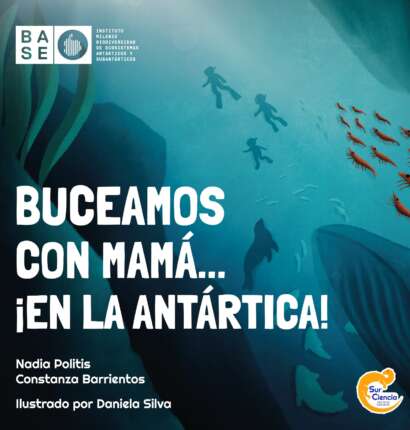
One of the first projects contemplated in the work between both institutions is the publication of the book “We dive with mum… in Antarctica!”, a work aimed at early childhood that highlights Antarctic biodiversity, marine ecosystems, and the leadership of women in polar science. The book, created by journalists Constanza Barrientos and Nadia Politis, had scientific advice from members of the Millennium Institute such as: Dr. Angie Díaz (UdeC), Dr. Karin Gérard (UMAG), Dr. César Cárdenas (INACH) and Dr. Elie Poulin (University of Chile). The illustrations were created by Magallanes artist Daniela Silva (@artpatagoniawild).
Educators Marcela Soto and Porfiria Barrientos advised on the pedagogical content of the work, which tells the adventures of a family from Punta Arenas, led by a researcher mother dedicated to scientific diving in Antarctica: “In early childhood, girls and boys are discovering the world and are highly sensitive to everything. While it is very important for them to have experiences and play outdoors, it is also important that, little by little, they approach reading together with their caregivers: observing images, listening to stories at a calm pace and letting them be protagonists of the reading experience, so they can point to words and turn the pages. Books like this help form readers from early childhood, showing that reading can also be an adventure to explore the world and discover new places,” reflects teacher Porfiria Barrientos.
The book “We dive with mum… in Antarctica!” will also have a preview at the 12th SCAR Open Science Conference (SCAR 2026), which will take place from 8 to 19 August in Oslo, Norway, and is organised by the Norwegian Polar Institute. “As a team, we will take part in the Art and Science session to share our experience of integrating stories, symbols and analogies to bring Antarctica closer to the youngest audiences. This represents an international milestone for our institute,” highlights Nadia Politis, director of Communications and Education at the BASE Millennium Institute, an ANID centre of excellence of the Ministry of Science, Technology, Knowledge and Innovation.
In the new project, Editorial SurCiencia will be responsible for the editing, publication, distribution and commercialisation of the first edition, as well as promoting its dissemination in bookstores, book fairs, libraries and educational spaces, in a first print run of one thousand copies. It also includes dissemination and promotion actions through launches, presentations in libraries, educational establishments and the media. More information at https://www.surciencia.cl
Source: BASE Millennium Institute and Editorial SurCiencia