El Doctor en historia Peder Roberts, analizará cómo el cambio climático afecta al sistema internacional que brinda gobernanza al continente austral: el Sistema del Tratado Antártico. El investigador principal del Instituto Milenio BASE, y académico de la Facultad de Derecho de la U. de Chile, Prof. Luis Valentín Ferrada moderará el encuentro, que se desarrollará en modalidad híbrida (física y virtual).

After a successful negotiation of the International Geophysical Year (IGA) of 1957-1958, it was in 1959 when the Antarctic Treaty was adopted in Washington D.C., United States, which entered into force in 1961. This agreement enshrines Antarctica as a continent for peace and scientific research. During the following decades, the international system regulated aspects such as environmental protection, the exploitation of living resources, tourism and non-governmental activities that are current regulations up to date. 

The Scientific Committee on Antarctic Research (SCAR) has warned in its latest report about the global impact of climate change in Antarctica, due to the increase in carbon emissions and other greenhouse gases. “This process will continue to affect the atmosphere and the Southern Ocean, with decisive consequences on the Antarctic and sub-Antarctic ecosystem,” the organization points out, and encourages the international community to take action.

To contribute to the reflection on the effects of climate change on the Antarctic Treaty System, international legislation, activity and scientific knowledge, Dr. Peder Roberts, on an academic visit to Chile, will hold the conference “Climate change: does it threaten the Foundations of the Antarctic Treaty System? The instance will seek to link the History of Antarctic Science with an analysis of the international system, and the effects of climate change on the sixth continent.

Peder Roberts is a Ph.D. in History (Stanford University), an Associate Professor at the University of Stavanger (Norway) and a researcher at the Division of History of Science, Technology and the Environment at the KTH Royal Institute of Technology (Sweden). He is one of the co-chairs of the Standing Committee on Humanities and Social Sciences of the Scientific Committee onAntarctic Research (SCAR) and leads the European Council Research project “Greening the Poles: Science, the environment and modern creation of the Arctic and Antarctica” (2017-2022).

The keynote speech will be held in English on June 16th, 2022 at 12:30 p.m. The meeting will take place in a hybrid mode, with virtual participation via Zoom (prior registration) and face to face participation at the Matilde Brandau room of the University of Chile Law School (Santa María 076, 6th floor, Santiago ). 

Photographs and text: BASE Millenium Institute/ N.Politis

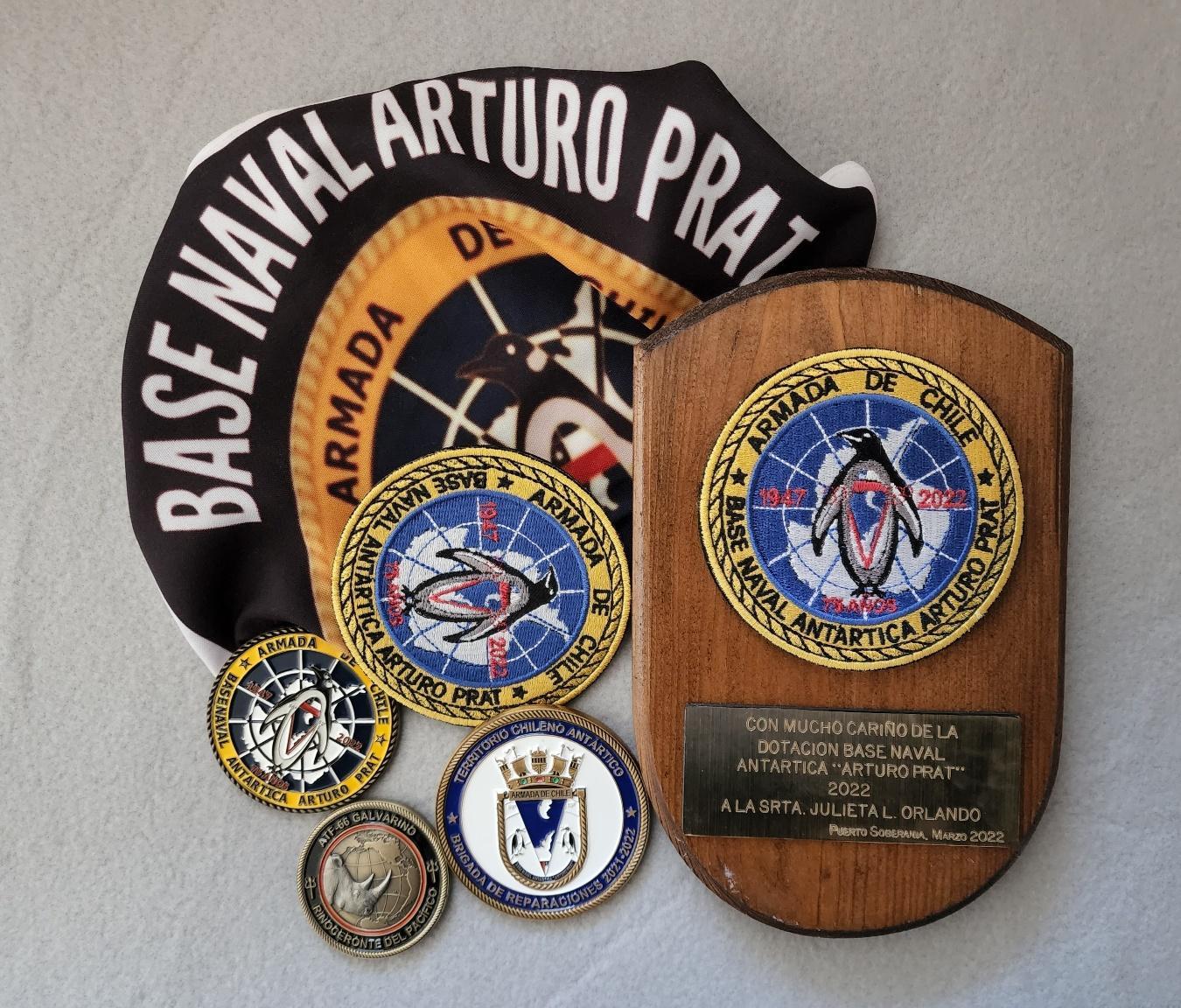
Within the framework of the Antarctic Scientific Expedition (ECA 58) of the Chilean Antarctic Institute (INACH), the naval institution highlighted the scientific career of Dr. Julieta Orlando, who stayed more than 30 days at the Captain Arturo Prat Naval Base , belonging to the Chilean Navy.

Julieta Orlando, Doctor of Sciences in Microbiology and deputy director of BASE Millennium Institute received recognition for teamwork, scientific performance in the field, direction of logistics and polar coordination. T

he Official Lieutenant Commander of the Sea, Eduardo Domínguez, who currently serves as Commander of Captain Arturo Prat Naval Base, highlighted Orlando’s 10 years of Antarctic experience, through the delivery of a Chilean Navy Coin: “I have had the opportunity to live in an INACH shelter, in scientific bases from the Army, the Navy, I have camped and sailed in seven different ships,” said the microbiologist, valuing the diversity of experiences she has obtained from Antarctic expeditions.

Arturo Prat Base, of the Chilean Navy, was a destination that emerged as a change of plans on the route, observes Dr. Orlando, since the Antarctic Scientific Expeditions (ECA) require coordination between teams and resource optimization. With this objective, she coordinated the collection of samples of the Neobuccinum eatoni snail for one of her colleagues, thus extending her southern stay from February to March 2022.

Between cueca dances, 24/7 gatherings and experiences of camaraderie and collaboration, Dr. Orlando was able to learn about the implications of a long-term stay in a base in Antarctic territory: “Being on the continent, one has the possibility of seeing different realities. It is different to be in a base of the Chilean Navy, in one of the Chilean Army, or in a facility where only civilians stay; as it is also very different to be on land than sailing”, says Julieta Orlando.

The gesture of the Naval Base Arturo Prat 2022 complement , is valued by the deputy director of the BASE Millennium Institute: “I feel very grateful, but I also feel that this is not an award, but rather the result of what Antarctic coexistence generates, and that has many edges. I feel that, even if I return to the same place, the experience is always different, and this expedition in particular was different because, unlike other opportunities, I was the only representative of our team of researchers, and I was able to adapt in a good way with the group at the base”, she reflects.

By: Constanza Barrientos.  


The agreement places scientific collaboration at the center of the institutional work, and it includes support for undergraduate and postgraduate students, academics and researchers, as well as the development of infrastructure and equipment for activities, programs and projects.

With the aim of promoting research, education and conservation of biodiversity in the Antarctic and sub-Antarctic regions, BASE Millennium Institute and the Institute of Ecology and Biodiversity (IEB) signed an institutional scientific collaboration agreement with the focus on human capital training.

The Faculty of Sciences of the University of Chile hosted the meeting between both institutions: “The members of BASE Millennium Institute have links with the IEB center and, in particular, several of our researchers have been trained in the institution, which facilitates our integration in the search for measures to implement and improve the conservation of Chile’s natural resources”, said Dr. Elie Poulin, Director of BASE Millennium Institute.

Dr. Aníbal Pauchard, Director of IEB highlighted the possibility of strengthening scientific work with a greater impact for society: “Integrate knowledge between these different centers of excellence, to the extent that these associations and cooperation agreements are made.”

The collaboration agreement, in addition to providing human, technical, logistical, infrastructure and equipment resources, seeks to develop joint actions focused on conservation and scientific communication to a wide audience: “We hope to contribute with new approaches, models and study sites to strengthen the development of cutting-edge research on biodiversity at the national level” highlighted Dr. Julieta Orlando, Deputy Director of the BASE Millennium Institute.

In terms of research, both centers will develop scientific collaborations and information exchange in the areas related to status and trends, integrity of ecosystems, agents of change in biodiversity, global warming and climate change, conservation and governance. At the same time, the support to undergraduate and postgraduate students, academics and researchers is planned, as well as the development of infrastructure and equipment for activities, programs and projects that are of interest to both the BASE Millennium Institute and the IEB.

Text: Constanza Barrientos and Carolina Todorovic.
Photos: BASE Millennium Institute / J.Orlando

Fernando Valenzuela (Gerente de IEB), Yasna Pardo (Directora ejecutiva), Aníbal Pauchard (Director IEB), Elie Poulin (Director Instituto Milenio BASE), Julieta Orlando (Directora alterna del Instituto Milenio BASE), Ramiro Bustamante (Secretario IEB) y Francisco Squeo (Presidente directorio IEB).

The student Constanza Paz Millán Medina obtained her Master of Science degree from the University of Chile, in a research led by Dr. Elie Poulin -director of the BASE Millennium Institute- as thesis director, and in a project carried out during the pandemic.

With the title “Patterns of genetic diversity and contemporary population structure in Siphonaria lateralis in the Southern Ocean”, the student Constanza Paz Millán Medina defended her thesis to qualify for the degree of Master of Science at the University of Chile, in a research that sought to evaluate the spatial genetic structure and the existence of contemporary gene flow of the limpet Siphonaria lateralis through SNP markers throughout its sub-Antarctic distribution, including populations from South America, Malvinas, South Georgia and the Kerguelen Islands. The study of these species is very relevant to understand the processes at the origin of the biogeography of the Southern Ocean, since it is only dispersed by means of large macroalgae, very abundant in sub-Antarctic areas.

The research was carried out within the framework of the Genomics Antarctic Biodiversity Ring (GAB) project and led by researchers from BASE Millennium Institute. Dr. Elie Poulin, as thesis director, and Dr. Nicolás Segovia and Dr. Claudio González-Wevar, as co-supervisors. In the defense ceremony, researchers Juliana Vianna and David Veliz participated as guest professors.

Millán highlighted that the species Siphonaria lateralis keeps a contemporary genetic connectivity between geographically distant locations of its distribution in the Southern Ocean, separated by thousands of kilometers, with the exception of the populations collected in the Malvinas Islands, which show to be genetically isolated and with a fairly endemic genetic diversity. At the same time, the SNP markers complement the history of Siphonaria lateralis previously described by traditional markers (DNA sequences).

The members of the evaluation commission highlighted the work of Millán Medina, considering the complexities of obtaining data, amid the COVID-19 pandemic. The thesis director, Elie Poulin, Ph.D. in Ecology and Evolution from University of Montpellier II, France, highlighted the research by pointing out that “the dispersal transport by rafting of gene flow is a very little explored area”, while Dr. Nicolás Segovia highlighted the level of research and the contribution to the polar discipline. Finally, Dr. Claudio González-Wevar joined in the congratulations and pointed out that the “idea that arises with traditional markers, which is added to a next stage, and is answering fundamental questions that we are asking to ourselves.”

Finally, the new Master in Sciences from the University of Chile, Constanza Paz Millán Medina, thanked her research tutors and reflected on the challenges that persist in the white continent: “The future does not look very auspicious for Antarctica under certain climate change models. Something that could be invasive, with high resilience to climatic conditions, could be able to enter all these subantarctic islands.”

Four professionals from Valdivia, Concepción and Santiago will join the institute to strengthen their scientific training in Antarctic and sub-Antarctic ecosystems, guided by researchers from the BASE Millennium Institute, within the framework of ANID National Doctorate Scholarship, 2022.

The National Agency for Research and Development of Chile (ANID) announced the results of the 2022 call  for the National Doctorate Scholarship. 900 applications out of  2,298 were selected to continue postgraduate studies in Chile and  371 of the selected applicants were between 26 and 30 years old (41.2%). The Minister of Science, Andrés Couve highlighted the results, noting that they will seek to strengthen the trajectories of those awarded, according to the “Talent Development Plan” promoted by the Science portfolio.

Formación doctoral que desde el Instituto Milenio Biodiversidad de Ecosistemas Antárticos y Subantárticos (BASE) será impulsada por sus investigadores principales: Desde Concepción, Pablo C. Guerrero, doctor en Ciencias, mención Ecología y Biología, profesor asistente de la Facultad de Ciencias Naturales y Oceanográficas de la Universidad de Concepción e investigador asociado del Instituto de Ecología y Biodiversidad (IEB) guiará a la nueva estudiante de doctorado Francisca Gálvez.

This doctoral training will be promoted by Millennium Institute Biodiversity of Antarctic and Subantarctic Ecosystems (BASE) through its main researchers. Pablo C. Guerrero, Doctor of Sciences, Ecology and Biology, assistant professor of the Faculty of Natural Sciences and Oceanographic of the University of Concepción and associate researcher of the Institute of Ecology and Biodiversity (IEB) will guide the new doctoral student Francisca Gálvez from Concepción.

Meanwhile, from Valdivia, Claudio González-Wevar, Doctor of Science with a mention in Ecology and Evolutionary Biology, researcher at the IDEAL Center and academic at the Austral University of Chile (UACh), will guide the new doctoral student Cristian Ríos, as well as the associate researcher of the Millennium Institute BASE, the doctor in Oceanography Andrea Piñones, who will advise the new doctoral student Albert Palominos.

Finally, in Santiago, Julieta Orlando, Alternate Director of the BASE Millennium Institute, Doctor of Science with a major in Microbiology and researcher at the University of Chile, will guide the new doctoral student Magdalena Osorio. Dr. Elie Poulin, director of the BASE Millennium Institute expressed  that they were  very happy with the results which were the beginning of a period that sought  to develop human capital, hand in hand with research, development of cutting-edge science and the contribution to decision-making, which, BASE Millennium Institute seeks to promote for the next 10 years.

As part of its work, BASE Millennium Institute will also seek to support the training of master’s students, along with the creation of scholarships and internships for undergraduate students. “We will also open spaces to incorporate disciplines such as Social Sciences, Journalism and Digital Communication as part of our vision, which is committed to the diversity and the transversality of knowledge,” Poulin pointed out.

ANID National Doctoral Scholarship aims to support the financing of doctoral studies in all areas of knowledge, taught by Chilean universities, for a maximum period of four years. Of the total number of people selected, 45.1% are women and 54.9% are men.


Led by the Ministry of Science and the Regional Government of Magallanes and Chilean Antarctica, 37 institutions from the public and private sectors, academia, research and international initiatives signed the document that formalizes their commitment to improve the lives of the inhabitants of the area, the country and the world, through research and innovation.

The objective of the declaration signed from Cerro de la Cruz viewpoint in Punta Arenas by 37 representatives of the public and private sector, academia, research, civil society and international initiatives, is the commitment to work collaboratively to consolidate the southernmost zone of Chile as a pole of sustainable development based on research and knowledge.

It is a declaration led by the Minister of Science, Andrés Couve, and the Regional Governor of Magallanes and Chilean Antarctica, Jorge Flies, which reinforces the commitment of different institutions “with the role of scientific and technological knowledge in the creation of value and as an engine of development, and to work decisively and collaboratively to turn the southern region into a pole that contributes, through research and innovation, to improving the quality of life of its inhabitants, the country and the world, building a country fully incorporated into the knowledge society”.

“I want to thank and acknowledge the tenacious work of all those who live in the southern cities of Chile, people who have worked tirelessly to build the Aysén and Magallanes region. Our recognition for their dedication for generations”, said Minister Couve at the beginning. As explained by the authority, this declaration seeks to take advantage of the opportunities given by the territory, especially around biodiversity, ecosystems, climate change and Antarctic research issues and the emphasis that researchers have given to the area of ​​paleontology, “a discipline that tells us to understand the past and through it, to understand the future”, explained Minister Couve.

“We appreciate the efforts of all institutions that today join this commitment, which is based on shared principles and values, such as sustainability, gender equity, transparency and national and international public or private collaboration,” added the secretary of State to highlight the commitment of different representatives who signed the declaration such as the Minister of Energy Juan Carlos Jobet, the undersecretary of military forces Alfonso Vargas; the Mayor of Punta Arenas Claudio Radonich, and the executive director of Imagen Chile, Constanza Cea.

Meanwhile, the regional governor stressed that “ Magallanes region will be a world science territory. The strategic alliance with the Ministry of Science has allowed us to identify, deepen and advance throughout the macrozone, which is united in what we want to do for the world with applied and basic science. The effort that is being made will position Chile and will allow us to look at Antarctica, the subantarctic area and our archipelagos to effectively answer questions as important as climate change or our biological and technical possibilities for new breakthroughs” .

“As the Ministry of Energy, we are committed to the sustainable development of the southern zone through a determined boost for clean energy and green hydrogen. This energy source will position the Patagonian winds at the heart of the global fight against climate change. We are sure that energy innovation, research and development in clean technologies will be the building blocks of the southern energy transition”, declared Minister Juan Carlos Jobet.

For Pamela Santibañez,  Seremi of Science of the Southern Macrozone, “this declaration is based on a common objective, to consolidate the regions of Aysén and Magallanes into a scientific and technological pole, understanding the magnitude of the information and knowledge available, which we seek to release in a collaborative way to face the planetary challenges to which we are exposed as humanity”.

“At Imagen de Chile we seek to position the country based on the talent of Chileans, which is what distinguishes us from the rest of the world. The world already knows Chile for its landscapes, we want them to know us for our creativity and ability to seek solutions to global problems. That is why what is happening in Magallanes is so relevant, it is aligned with establishing an identity, which has to do with exploring, going further, seeking solutions that integrate this exceptional territory that we have with talent and the ability to connect with needs that are outside and with the hope of finding answers”, assured Constanza Cea, the executive director of Imagen de Chile.

According to the words of the authorities, the specific actions and evaluation mechanisms that emanate from the declaration will be related to three axes: “I+D+i”; “People” and “Region”.

The first refers to the promotion and incorporation of research, development and innovation activities in the work of the participants; the second seeks to promote actions that benefit people, including the distribution of knowledge, equity and employability; while the latter focuses on internationally promoting the specific characteristics of the southern regions of the country, as well as raising awareness regarding the care of their seas, land and ice.


Signatories of the Declaration of Punta Arenas:

  • Ministry of Science, Technology, Knowledge and Innovation
  • Ministry of energy
  • Regional Government of Magallanes and Chilean Antarctica
  • Undersecretary of Armed Forces.
  • Chilean Navy
  • Municipality of Punta Arenas
  • CTCI Council
  • Image of Chile
  • German Embassy
  • French Embassy
  • Embassy of the United Kingdom
  • INACH
  • REUNA
  • CHIC-UMAG Center
  •  Millennium Institute Biodiversity of Antarctic and Sub-Antarctic Ecosystems (BASE)
  • Research Institute for Development (IRD)
  • GIZ
  • CEQUA
  • University of Aysen
  • Heidelberg Center for Latin America – HCLA
  • Fraunhofer Chile with its Solar Energy Center
  • IMPA / Antarctica XXI
  • HIF
  • Total Eren Chile
  • Engie
  • CEA-Liten
  • Seche Group
  • Veolia
  • Sulo
  • Thales 
  • EDF
  • Siemens Energy
  • Representation  of the Federal State of Bayern for South America
  • Ponant
  • Magellan Salmon Farmers Association
  • WCS Magallanes
  • Siemens Stiftung Latin America
  • Natural History Museum of Paris
  • Laboratory of Evolutionary Genetics of the Institute of Ecology, UNAM
  • German Academic Exchange Service – DAAD
  • Deutsche Forschungsgemeinschaft – DFG

Article published on: https://www.minciencia.gob.cl/noticias/declaracion-de-punta-arenas-un-polo-de-conocimiento-para-el-desarrollo-sostenible-en-la-region-mas-austral-del-planeta/

Five research teams will be deployed from the Antarctic Peninsula to Margarita Bay, to develop cutting-edge science, and start the interdisciplinary work that Millennium Institute Biodiversity of Antarctic and Sub-Antarctic Ecosystems (BASE), led by the University of Chile, will seek to boost  for more than a decade.

Projects that start their Antarctic campaigns independently, but that will seek to contribute to an associative approach and international collaboration, is the context that involves the end and start of two great proposals of excellence: On the one hand, the Genomics Antarctic Biodiversity Ring project ( GAB), made up of researchers from the University of Chile, the Catholic University, the University of Concepción, the Austral University and the University of Magallanes, reaches its last year of execution. The recently awarded Millennium Institute  Biodiversity of Antarctic and Sub-Antarctic Ecosystems (BASE), headed by professors from the Faculty of Sciences of the University of Chile, Elie Poulin and Julieta Orlando, begins its prosperous stage of cross-disciplinary development .

On board the ship Betanzos (DAP company), the Genomics Antarctic Biodiversity (GAB) Ring project team, led by the Doctor in Microbiology, researcher at the Microbial Ecology Laboratory (LEMi) and deputy director of the BASE Institute, Julieta Orlando, who will embark on the so-called deep Antarctica for almost a month. She said that it was the third campaign in which they had been able to participate with the ring project, and among its impacts was the link with  BASE institute.

Betanzos is a 70 meters long ship with a capacity of up to 60 people on board, it will also contribute to the work of researchers Guillaume Schwob, a postdoctoral researcher sponsored by Julieta Orlando, Sebastián Rosenfeld, Daly Noll, Fabiola León and Eduardo Pizarro, members of the Science and Technology Research Ring (PIA) project ACT172065.

On the other hand, BASE Institute researchers Angie Díaz and Karin Gérard will also carry out collaborative research on Antarctic biodiversity. Miss Díaz, Doctor in Sciences with a mention in Ecology and Evolutionary Biology, will work in the field within the framework of her Fondecyt initiation project “Cryptic speciation in the Antarctic Ocean: integration of genomics, morphology and species distribution models to elucidate the speciation process of a group of gastropods”, hosted by the University of Concepción. Miss Diaz  will stay at the Captain Arturo Prat naval base, belonging to the Chilean Navy, throughout February. She said that her  work would play a key role in contributing to the understanding about the mechanism(s) responsible for the speciation process of a group representative of the endemic marine fauna of the southern ocean, and how the climatic history of the environment has shaped this process.

In parallel, Karin Gérard, diver and doctor of Biological Oceanology, will dive in the frozen Antarctic waters of Fildes Bay, as a researcher associated with the Laboratory of Antarctic and Sub-Antarctic Marine Ecosystems of the Patagonia Institute, of the University of Magallanes, together with Zambra López, marine biologist and doctoral student in Sciences, mention in Ecology and Evolutionary Biology, from the University of Chile. She highlighted that scientific diving would be essential to have direct access to organisms in their natural environment, to their distribution within communities, to be able to appreciate the diversity of forms and habitat of Antarctic species and photograph them. “Furthermore, with scientific diving, collecting benthic animals by hand, we are avoiding a destructive impact on the marine ecosystem”, she said.

Collaboration and synergy that from Puerto Williams will also be promoted by the associate researcher University of Magallanes, and lead investigator of Millennium Institute Biodiversity of Antarctic and Sub-Antarctic Ecosystems (BASE) and the Cape Horn International Center (CHIC), Tamara Contador, within the framework of her study of the impacts of climate change on freshwater organisms and invertebrates: “With Claudia Maturana, PhD in Ecology and Evolution, and recipient of the award For Women in Science from L’Oréal and UNESCO, we are collaborating across teams, so that her research is also a direct link to our line of work in Antarctic and Sub-Antarctic ecosystems, as well as her postdoctoral Fondecyt sponsored by me and the IEB”, she pointed out.

A fourth research team will be located at the Chilean Navy’s Captain Arturo Prat naval base, with Valentina Bernal and INACH project “Patterns of connectivity and selection in Harpagifer antarcticus in Maritime Antarctica: A focus on early life stages”, under the direction of Elie Poulin and the University of Chile.

Upon her return, Miss Bernal  will have to undergo an exhaustive process of data interpretation and analysis, such as the one carried out by Léa Cabrol’s team, associate researcher at BASE Institute and attached to the Institute of Ecology and Biodiversity, after a month spent at Prof. Julio Escudero base from INACH, and Fildes Bay in Antarctica, at the beginning of the southern summer (December 2021). This task was carried out together with Elie Poulin, within the framework of the regular Fondecyt project “Microbial biogeography in the Southern Ocean: from communities to oligotypes” hosted by the IEB: “This research will seek to establish distribution patterns of microorganisms throughout the Southern Ocean from Kerguelen to Patagonia and the Antarctic Peninsula. In addition to comparing them with the biogeography of macro-organisms about which much more is known to date”, highlighted the doctor in Bioprocesses from the University of Montpellier II, France, who leads the project.


Ecosystem monitoring network

Due to the fact that sample locations vary between one Antarctic campaign and another, the 2022 season will allow polar researchers to add new sampling points, which will allow strengthening an approach oriented towards Biogeography, that is, the study of the distribution of species in the southern territory. “If we want to effectively see the changes that are taking place, we have to broaden the range of study. For this reason, these complementary expeditions will allow us to obtain a picture of the current picture with gradients of climatic conditions, which will facilitate the predictions that we will implement at BASE Institute ”, highlighted Julieta Orlando.

“We are also going to take advantage of logistical prospecting, that is, identifying the points that could be more feasible for long-term observation of biodiversity, which we must start next year with BASE Institute,” said Elie Poulin, director of the Millennium Institute Biodiversity of Antarctic and Subantarctic Ecosystems. For this reason, the installation of Autonomous Reef Monitoring Structures, known as ARMS, will represent a challenge in terms of logistics since the teams will have to ensure their protection on the seabed, away from meteorological variations, strong currents, or the presence of marine animals, which could prevent its subsequent annual recovery. Hence the importance of monitoring the southern territory, after crossing the Antarctic Circle at parallel 66°S.

The installation of these new “Biodiversity Observatories” promoted by BASE Institute, will seek to obtain records of marine animals, such as molluscs, gastropods, algae, phyto and zooplankton, as well as various microorganisms. This will be complemented by the collection of samples on land, with the study of penguins, skuas and petrels, along with the analysis of invertebrates in the intertidal, the transition zone between land and marine space, together with the collection of soil samples in penguin colonies, lake water and sediments, for the study of microbial diversity.  Julieta Orlando concluded that “we need to have a record of the same species in various sample sites, to determine how individuals from the north of the Antarctic Peninsula differ at the genetic level, with those from the south, in the southernmost tip of the white continent.”

Monday, January 17, 2022
Text: Nadia Politis
Biodiversity Millennium Institute of Antarctic and Sub-Antarctic Ecosystems (BASE)