With the aim of developing initiatives for the study and conservation of biodiversity at the national level, based on scientific evidence and the use of data, the scientists from the BASE Millennium Institute PhD. Claudia Maturana and Melisa Gañán will add their knowledge of Antarctic and sub-Antarctic biodiversity.

May 03, 2023.- Promote and encourage free access to biodiversity data in the country and promote collaboration between national and international initiatives related to biodiversity data, are part of the objectives of the GBIF Chile Node, and that after the creation of a multisectoral work group, will have the participation of Claudia Maturana, PhD in Ecology and Evolutionary Biology and affiliated researcher at the BASE Millennium Institute, and Melisa Gañán, a doctoral student from the BASE Millennium Institute and the University of Barcelona.

Doctoral researcher at the BASE Millennium Institute, Melisa Gañan. Photo: BASE Millennium I./ N. Politis

Thus, with the aim of drafting a governance proposal for the GBIF Chile network that allows the development, in its implementation, of a collaborative framework of community policies, agreements, norms and standards, systematic work has begun with researchers: “The results they will be proposed to interested parties to guide the exchange, publication, management and use of data on biodiversity in Chile”, points out Melisa Gañán, also a researcher at the University of Magallanes, of the Millennium Nucleus of Southern Invading Salmonids (INVASAL) and the Cape Horn International Center (CHIC).

The work also seeks to articulate the work of the different public and private representatives that provide Biodiversity data and determine how public policies in the country can be strengthened: “Before, anyone who wanted to be part of the collaborators could upload data, but now they You want to create a policy that protocolizes and shapes the data. What is published, how they impact and which ones could have priority”, says PhD. Claudia Maturana, also a researcher at the Institute of Ecology and Biodiversity (IEB) and the CHIC Center.
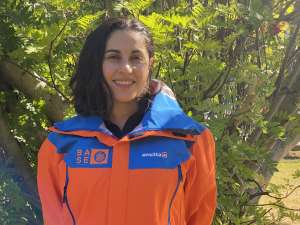
Attached researcher at the BASE Millennium Institute, Melisa Gañan. Photo: BASE Millennium I./ C. Barrientos

Thus, the Millennium Biodiversity Institute of Antarctic and Sub-Antarctic Ecosystems (BASE), the Millennium Nucleus of Southern Invading Salmonids (INVASAL), and the Institute of Ecology and Biodiversity (IEB) through the researchers Gañán and Maturana, will actively work on the table of governance to design an articulated operating structure. This structure, even with an initial development, “will make it possible to face challenges in terms of management and information on the country’s biodiversity”, both scientists emphasize, with research work in Santiago and Puerto Williams.

GBIF or Global Biodiversity Information Facility is an intergovernmental initiative that arises from the Organization for Economic Cooperation and Development (OECD), with the aim of creating an accessible information network on biodiversity, in order to facilitate and promote scientific research. The GBIF Chile Node is managed by the Ministry of the Environment (MMA) which, as a signatory entity, is responsible for its implementation.

The governance table is made up of representatives from public sector institutions, universities, scientific entities, the private sector, museums, non-governmental organizations and citizen science, all GBIF partners who must have experience in publishing biodiversity data. Specifically, this Board is made up of the Millennium BASE Institute, the University of Chile, the University of Magallanes, the Undersecretary of Fisheries and Agriculture (SUBPESCA), the National Forestry Corporation (CONAF), the Ministry of the Environment (MMA), Econativa Consultores, Cienciambiental Consultores, the Center for Applied Ecology and Sustainability (CAPES), Museum of Natural History, Museum of Zoology of the University of Concepción, and the NGO Alianza Zona Norte de Quilpué.

More information at https://gbifchile.mma.gob.cl/


By: Nadia Politis and Marcelo Sotomayor

Main photography: BASE Millennium I./ Claudia Maturana

A work carried out by researchers from the Millennium Institute BASE and the Microbial Ecology Laboratory (LEMi) of the University of Chile and which seeks to contribute to the description and conservation of the biodiversity of the ecosystems associated with lichens in the Aysén region and the Magellan region.

April 6, 2023.- The largest collection of basidiomycete yeasts isolated from the thallus of Peltigera lichens and the first collection of yeasts associated with lichens from southern Chile, was published in the Global Biodiversity Information Facility (GBIF) by researchers from the Millennium Institute BASE and the Microbial Ecology Laboratory (LEMi) of the University of Chile, guided by Dr. Julieta Orlando.

The initiative was led by Yosbany Pérez, a doctoral student from the University of Chile and also a researcher at LEMi and the Millennium Institute BASE, who pointed out that the work carried out “provided evidence that lichens would act as a specific niche that harbors different microorganisms, including yeasts. Those that are currently considered a new essential component of the symbiosis of lichens. This helps to provide more information about the components of the lichen mycobiome and, therefore, to enhance the conservation of these microorganisms and the ecosystems that surround them.”

The collection studied comprises 180 basidiomycete yeasts isolated and identified from the thallus of four Peltigera lichen species (P. frigida, P. fuscopraetextata, P. rufescens and P. antarctica) collected in southern Chile, specifically in the Coyhaique National Reserve and the Patagonia Natural Park, Tamango sector, located in the Aysén region of General Carlos Ibáñez del Campo; and in the Karukinka Natural Park and Navarino Island, located in the Magallanes and Chilean Antarctic region.

This study is the first to describe the presence of basidiomycete yeasts in Peltigera lichens. A great diversity of genera of basidiomycetes was found, belonging to the classes Agaricostilbomycetes, Cystobasidiomycetes, Microbotryomycetes and Tremellomycetes. The phylogenetic analyzes carried out suggest the presence of species not reported so far, requiring additional biochemical and physiological studies to describe these potential new species.

Basidiomycete yeast isolates. Image of Yosbany Pérez, doctoral student at the Millennium Institute BASE.

Some basidiomycete yeasts reported in association with lichens have a lifestyle completely dependent on them, so it is highly probable that the lichen species studied are reservoirs of unreported yeasts. The identification of these new yeast species could have future applications in research, for example, in the field of biotechnology.

“It is very important for the entire scientific community that there be free access to these data, so that any research team that needs the information can consult and use it. This platform (GBIF) allows anyone to access the database and be able to think about other investigations”, indicated the data manager of the Millennium Institute BASE, Catalina Marín, who worked with the team in the publication of the data.

For her part, PhD. Julieta Orlando, Alternate Director and principal investigator of the Millennium Institute BASE, stated that “we are committed to ensuring that the information we generate reaches various audiences, since we believe that knowledge of the biodiversity of Antarctic and sub-Antarctic environments it must not only reach decision makers, one of our fundamental objectives, but also other scientific teams and the community in general.”

“We are convinced that, through this transfer of knowledge, it will be possible to generate the necessary awareness to protect the biodiversity of these environments. In this sense, the publication of repositories of various organizations in GBIF is essential for us to make research data easy to find, accessible, interoperable and reusable (FAIR principles)”, added the director of LEMi.

The team was also made up of researchers from LEMi and the University of Chile: Nayla Serey, Natalia Lizana, Katerin Almendras and Juana Leal; and by the academic from the Department of Biology, Geology, Physics and Inorganic Chemistry of the Rey Juan Carlos University (Spain), Ana María Millanes.

Find the collection here https://doi.org/10.15468/hw7k9r

READ MORE>> Through the GBIF Chile platform, the Instituto Milenio BASE team promotes the democratization of data on biodiversity


Main picture: Peltigera lichens by M. Insitute BASE/ Julieta Orlando