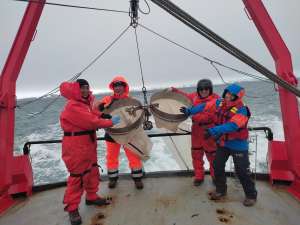
Aboard the French research vessel Le Soléal (Ponant Cruises) collaborative effort between PhD. Claudio González-Wevar (UACh/BASE/IDEAL) and Professor Hamish G. Spencer (University of Otago) combines expertise in molecular genomics, evolutionary biology, and biogeography to investigate the distribution, diversity, and evolutionary history of molluscs in the Southern Ocean’s unique and understudied ecosystems. The expedition aims to advance the understanding of subantarctic molluscs through detailed collection and study.

Marking their tenth expedition, the BASE Millennium Institute and Ponant Cruises continue groundbreaking research, this time on Macquarie, Stewart and Auckland Islands, led by PhD. González-Wevar, head of the Laboratory of Antarctic and Subantarctic Molecular Genomics and Ecology (LAGEMAS-UACh). The project is also strengthened by the expertise of Professor Hamish G. Spencer, Sesquicentennial Distinguished Professor from the Department of Zoology at the University of Otago, New Zealand. Together, the team focuses on sampling and analyzing intertidal ecosystems, highlighting the importance of these islands, which host key study groups such as mollusc species Nacella (e.g., terroris, macquariensis), Laevilitorina (e.g., mcphersonae, venusta), and Margarella (e.g., violacea, macquariensis), among others.

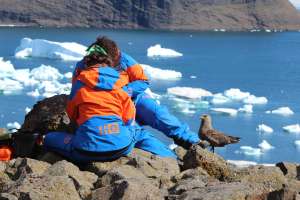
The scientific work involves sampling from the subantarctic intertidal zone. Image: Hamish Spencer

“The participation of PhD. Hamish Spencer from the University of Otago has been invaluable. His expertise enabled us to access Stewart Island and collect specimens for our studies”, González-Wevar adds. The expedition covers rare and remote locations, including Traills Bay, the Auckland Islands in New Zealand, and Macquarie Island in Australia. These areas offer unparalleled opportunities for understanding biodiversity and ecological dynamics.

Professor Hamish G. Spencer, underscores the significance of the research: “The biogeography of the Southern Ocean is fascinating and yet understudied. Nevertheless, we have long understood that the world’s strongest oceanic current, the Antarctic Circumpolar Current (ACC), is the major physical player in the distribution of organisms in the subantarctic. In a long-standing collaboration with Professor Claudio González-Wevar of BASE, I am interested in understanding how long-distance dispersal in the ACC has shaped the marine biodiversity around the shores of the Southern Ocean. We have used molluscs as our model organisms and have previously collaborated on projects about limpets (Nacella and Siphonaria), topshells (Margarella), and periwinkles (Laevilacunaria and Laevilitorina)”.

Spencer elaborates on the mission’s goals: “We now want to expand our work to include more populations and species from the New Zealand and Australian subantarctic islands (Auckland, Campbell and Macquarie). These islands are especially important because they have acted as refugia for some species during past Ice Ages. We are aiming on this cruise to collect samples of all of the above genera, as well as some others for new projects (e.g., the bivalve Gaimardia). Our preliminary work on some of these groups suggests that there has been significant evolutionary radiation in this region, even though it is connected by long-distance dispersal to Patagonia, the Antarctic Peninsula, and the subantarctic islands in the Atlantic and Indian sectors”.
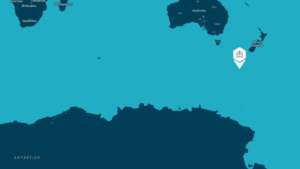
The Auckland and Campbell Islands (New Zealand) and Macquarie Island (Australia) are key sites for scientific research.


A Partnership Driving Scientific Excellence

Since 2022, the collaboration between the BASE Millennium Institute and Ponant Cruises has paved the way for groundbreaking research. “This partnership allows us to conduct more and better science while strengthening ties with world-class research teams”, says PhD. Elie Poulin, director of the BASE Millennium Institute.

PhD. Claudio González-Wevar and Phd. Hamish Spencer embarking on a subantarctic expedition.
Image: C. González-Wevar

Together with Dr. Spencer, González-Wevar delves into population genetics, phenotypic plasticity, phylogenetics, and the unique characteristics of New Zealand molluscs. The Auckland, Campbell, and Macquarie Islands are pivotal to their work, particularly Macquarie Island, which UNESCO declared a World Heritage site in 1997. This island’s geological significance, as the only location where mantle rocks are exposed above sea level, underscores its importance for scientific inquiry.

Professor Spencer concludes: “The ultimate goal of our work is to explain the origin of intertidal and nearshore Southern Ocean biodiversity, especially the range of evolutionary outcomes, from widespread species to island-group endemics”.

UNESCO highlights New Zealand’s subantarctic islands as biodiversity hotspots where Antarctic and subtropical waters converge, fostering high marine productivity and unique ecosystems. “These islands boast significant endemism, especially among birds, plants, and invertebrates”, the organization points. This biodiversity underscores the global significance of research conducted by González-Wevar and his team.


By: Nadia Politis, BASE Millennium Institute

Main picture: French vessel Le Soléal, operated by Ponant Cruises. By Hamish Spencer.

The installation of biodiversity observatories and the collection of samples for genomic studies were some of the activities carried out this 2022-2023 Antarctic season by researchers from the BASE Millennium Institute on the white continent.

April 11, 2023.- At least 30 researchers from the Millennium Institute BASE were part of the LIX Antarctic Scientific Expedition (ECA 59) coordinated by the Chilean Antarctic Institute (INACH). From January to early March 2023, they carried out work in various areas of the Antarctic peninsula and the South Shetland islands.

Biodiversity observatories

In the area of ​​Bahía Fildes, King George Island, a team led by the principal investigator of the Millennium Institute BASE, also the University of Magallanes, PhD. Karin Gerard, carried out the installation of the Autonomous Reef Monitoring Structure (ARMS) of the Marine Observatory. In addition, recordings were made with benthic sleds, sample collection with trawls and phytoplankton nets.

l’s teama Dra. Karin Gerard was made up of an academic from the Universidad Austral of Chile (UACh) and researcher at the Institute of Marine and Limnological Sciences (ICML), Vincente Villabolos; the academic of the University of Sorbonne and researcher of the Station Marine Concarneau of the National Museum of Natural History of France, PhD. Cyril Gallut; and the professional diver, Alberto Ahumada.

For its part, the team led by the PhD. Tamara Contador, an academic at the University of Magallanes and a researcher at the Millennium Institute BASE, the Cape Horn International Center (CHIC), and the Millennium Nucleus of Southern Invasive Salmonids (INVASAL), installed sensors to measure environmental parameters, and collected samples of freshwater and terrestrial invertebrates, in the area of ​​Fildes Bay, Ardely Peninsula and Deception Island.

The installation of the sensors and the sampling were carried out within the framework of the Earth Observatory project together with the academic from the Catholic University of Maule, also an adjunct researcher at the Millennium Institute BASE and CHIC, PhD. Hugo Benítez.

Photograph by Melisa Gañan, doctoral student at the Millennium Institute BASE.

Terrestrial ecology team

PhD. Tamara Contador and PhD. Hugo Benítez also carried out monitoring of fly populations Parochlus steinenii on King George Island, Deception Island and Nelson Island, sampling of Chicken branchinecta and Bockella poppei (within the framework of the postdoctoral project of the researcher affiliated with the Millennium Institute BASE, PhD. Claudia Maturana) and collection of the invasive fly Trichocera maculipennis on King George Island. In the places where they found populations of Parochlus steinenii, B. gainii and B. poppei, made chemical measurement of the lake water.

For her part, the doctoral student at the Millennium Institute BASE, Melisa Gañan, who was aboard the DAP Mares vessel Betanzos, surveyed the land in search of the winged fly Parochlus steinenii, associated with lakes and lagoons, and the wingless fly Belgium Antarctic, which is associated to a greater extent with mosses and terrestrial plants such as Deschampsia antarctica and Colobanthus quitensis

Next to Melisa Gañan, ishad the undergraduate student at the University of Concepción (UdeC), Micaela Conejeros, who works together with the principal investigator of the Millennium Institute BASE, also a UdeC academic and director of the Biogeography, Macroevolution and Systematics Laboratory (BIOMAS) PhD. Pablo Guerrero. Micaela is dedicated to the search for vascular plants such as Deschampsia antarctica and Colobanthus quitensis.

Photograph by Daniela Nualart, doctoral student at the Millennium Institute BASE.

Collection of lake samples and freshwater invertebrates

The PhD. Angie Díaz, academic at the University of Concepción (UdeC) and principal investigator at the Millennium Institute BASE, together with a doctoral student from the University of Chile, Sebastian Rosenfeld, sailed for 15 days on the DAP Mares vessel Betanzos. By means of diving and collecting on the coast, they obtained samples of marine invertebrates (echinoderms, molluscs and crustaceans) with the aim of generating a biodiversity inventory of the eastern sector of the Antarctic peninsula.

On the other hand, the doctoral student from the University of Chile and the Millennium Institute BASE, Diego Ahumada, dedicated himself to collecting water and sediment samples from 11 different lakes on King George Island, and measuring physicochemical parameters of the water (pH, temperature, dissolved oxygen, turbidity and conductivity) with the aim of studying the bacterial communities of this ecosystem. .

Collection of marine vertebrates

In the area of ​​King George Island, UACh academics and researchers from the Millennium Institute BASE and the IDEAL Center, PhD. Luis Vargas- Chacoff and PhD. Kurt Paschke, together with the doctoral student from the UACh, Centro IDEAL and Millennium Institute BASE, Daniela Nualart, they collected adult fish (Antarctic Harpagifer) and amphipods (Gondogeneia antarctica, Cheirimedon femoratus and Gliptonotus antarcticus) for physiological studies. The team worked together with the Cont Anadromous Fish Research Center of United States, Steve McCormick, and the researcher from the University of Algarve in Portugal, Pedro Guerreiro.

PhD students from the University of Chile and the Millennium Institute BASE, Valentina Bernal and Francisca Rodriguez, also collected samples of Antarctic Harpagifer but in the larva stage and with the support of a bongo network on Greenwich Island, in order to carry out genomic studies.

Photograph of Valentina Bernal, doctoral student at the Millennium Institute BASE.

Study of habitats and sampling for genetic analysis in Antarctic birds

ECA 59 also had the participation of undergraduate, master’s and doctoral students from the Instituto Milenio BASE, as was the case of the UACh doctoral student, also the IDEAL Center, Albert Palomino, and the undergraduate student from the Pontificia Universidad Católica de Chile (PUC) and the UC Molecular Biodiversity Laboratory (directed by PhD. Juliana Vianna), Elisa González, who camped for 70 days at Punta Armonía, Nelson Island. The objective of his stay was to carry out biological sampling, aerial and ground counts, and breeding and post-breeding tracking in chinstrap penguin colonies, under the leadership of the INACH and BASE Millennium Institute researcher, Dr. Lucas Krüger.

More members of the UC Molecular Biodiversity Laboratory team were also present at ECA59. In the vicinity of the General Bernardo O’Higgins base, Claudia Ulloa, a researcher from the Instituto Milenio BASE, along with PUC doctoral student Beatriz Esnard and PUC master’s student Eduardo Pizarro, carried out ecological monitoring studies in gentoo and chinstrap penguins. They carried out the installation of GPS and the obtaining of blood samples, with the aim of studying the use of the habitat by breeding penguins.

Likewise, the UCH doctoral researcher, Daly Noll; the doctoral student of the Andrés Bello University (UNAB), Lucila Morales; and the PUC undergraduate student, Josefina Jorquera; they collected samples of penguins, skuas and cormorants, during the 15 days they were sailing on the Betanzos vessel.

Photograph by Daly Noll, doctoral student at the Millennium Institute BASE.

Works based Professor Julio Escudero

The principal investigator of the Millennium Institute BASE, also a researcher at INACH, PhD. César Cárdenas, remained for about 30 days in the place, carrying out tasks as Head of Base Professor Julio Escuderodel INACH, coordinating the logistical and scientific activities offurther of 12 projects developed during said period.

The doctoral student from the University of Chile, also the Millennium Institute BASE, Magdalena Osorio, Professor Julio Escudero also remained at the base of INACH. The purpose of his stay was to analyze the technical feasibility of being able to carry out his project during the next ECA60 and the logistical requirements to be able to carry out experiments in the aquariums of said base.


Main pictura: M. Institute BASE/ Hugo Benítez

Through an international collaboration between SEDNA Expeditions and the Millennium Institute for Biodiversity of Antarctic and Sub-Antarctic Ecosystems (BASE), a group of scientists navigated the frozen waters of the Weddell Sea to carry out studies on microorganisms, lichens, mosses, flowering plants, algae, marine invertebrates, fishes, Adelie and emperor penguins.

Antarctica, January 10th, 2023.- An international collaboration has never been seen before, was the result of the work between SEDNA Expeditions and the BASE Millennium Institute in the 2022-2023 Antarctic campaign that was developed together with scientists from France, the United Kingdom, the United States, and Chile.

With the aim of studying microorganisms, lichens, mosses, flowering plants, algae, marine invertebrates, fishes, and Antarctic seabirds including Adelie and emperor penguins, a group of researchers from the BASE Millennium Institute traveled to one of the most unexplored points of the Antarctic continent, the Larsen B platform, on a 15-day expedition that took them across the Atlantic Ocean and the Weddell Sea.

“This expedition is a pioneer of its kind since it integrates international collaborative work between scientific research, tourism, and science communication, and it allowed us to obtain data from an area little explored by science”, says the director of the BASE Millennium Institute, Dr. Elie Poulin. This collaborative work is the result of an alliance with the SEDNA Expeditions company based in France.

Nicolas Dubreuil, the co-founder of SEDNA Expeditions, highlights the importance of integrating scientific knowledge into Antarctic tourist experiences, with the aim of raising awareness of the contribution of polar research among passengers from all parts of the world: “it has been a great experience working with the BASE Millennium Institute and other groups of scientists, and I believe that today -more than ever- it is very important to bring science closer to people”.

 Alex Ionescu, a world-recognized technology expert, innovator, and investor who was the promoter of the expedition, highlights the International Scientific Collaboration Expedition as a sign of joint work to protect Antarctic ecosystems: “I think it is very important to work together, listen to science and understand that our planet is the only one and that we must protect it”.

 The scientific research team collected samples and data in the field and gave popular science talks to the expedition passengers. In addition, the communication team recorded 360° videos and sounds, to be used in the project “Antarctic Metaverse: a journey of exploration to discover the biodiversity of the Southern Ocean”, which will be carried out this year as a result of the award of the “Public Science Fund” of the Ministry of Science, Technology, Knowledge, and Innovation of the Government of Chile.

The “International Scientific Collaboration Expedition: the Weddell Sea and Larsen Ice Shelf” was composed of BASE Millennium Institute: Dr. Elie Poulin, Dr. Julieta Orlando, Dr. Léa Cabrol, Dr. Juliana Vianna, Dr. Claudio González-Wevar, Dr. Pablo Guerrero, Dr. Máximo Frangopulos, Fabiola León, Dr. Alejandro Pérez-Matus (Pontificia Universidad Católica de Chile and Millennium Nucleus of Ecology and Conservation of temperate mesophotic reed ecosystems, NUTME) and Nadia Politis. The team was also supported by Carla Badani (Universidad de Chile) and Diego Ramírez (patrimonioaccesible.cl).

Text: Nadia Politis | Photo: Julieta Orlando