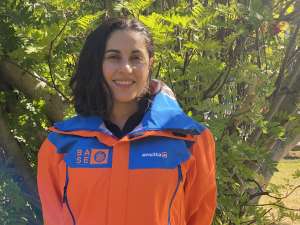
Together with sub-Antarctic research teams, the alternate director of the Millennium Biodiversity Institute of Antarctic and Subantarctic Ecosystems (BASE), PhD. Julieta Orlando, participated in coordination, interdisciplinary and scientific collaboration sessions.
In a meeting around international collaboration, scientific development and knowledge transfer, the Cape Horn Subantarctic Center inaugurated this Monday, May 15, its research center in Puerto Williams, with the aim of promoting excellent research from the Region Magellan and Chilean Antarctic.

The milestone was attended by government authorities such as the Municipality of Cabo de Hornos, the Regional Government of Magallanes and the Chilean Antarctic, the Ministry of Public Works, and the National Agency for Research and Development (ANID), the Chilean Antarctic Institute (INACH), together with representatives of the academy such as the University of Magallanes (UMAG), University of Chile, Pontificia Universidad Católica de Chile (UC), scientific research centers such as the GAIA Antarctic Research Center UMAG, Millennium Nucleus of Invasive Salmonids (INVASAL), Institute of Ecology and Biodiversity (IEB), and the community of Puerto Williams as artisans from the province and the Donald Mc Intyre Griffiths High School.
An environment of cooperation and exchange of knowledge that was highlighted by the Regional Governor of Magallanes and the Chilean Antarctic, Jorge Flies, who emphasized the local perspective that will be promoted from Puerto Williams: “The great dream is for it to be a region of world science. That is where having the BASE Millennium Institute, the University of Magallanes with CADI-UMAG, and what in a few years will be the International Antarctic Center (CAI), will allow us to achieve the highest rate of scientists per population in America, with 1 in every 120 inhabitants”, he pointed out.
While the CHIC director and principal investigator PhD. Ricardo Rozzi, highlighted the interdisciplinary work between centers: “Collaboration is a necessary condition to address problems that are complex, and the BASE-CHIC couple expresses the complementarity in collaborations, as a couple mutualist. This avoids, with limited resources, redundancy, which leads to instruments shared by BASE and CHIC, contributing to the ecosystem of centers of excellence in the Antarctic capital of Chile”.
While the director of the UMAG headquarters in Puerto Williams, Francisca Massardo highlighted collaboration as a tool for global change, to contribute to the study of environmental crises: “I think that having an infrastructure of the quality we have is a privilege and a permanent invitation to people to approach and develop research that has many points of view, to generate results among people”, he said.
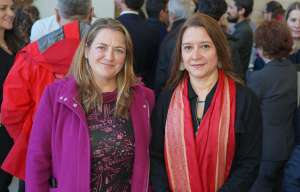
Collaboration from the Millennium Biodiversity Institute of Antarctic and Subantarctic Ecosystems (BASE) was represented through its alternate director, PhD. Julieta Orlando: “It is essential to link up, participate, and continue strengthening our ties with the Cape Horn International Center (CHIC), since we are not only linked through a shared affiliation of our researchers and researchers, but we are also building collaboration through work in research laboratories and the training of human capital with doctoral students”, she said.
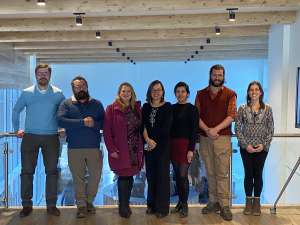
PhD. Orlando, also an academic at the University of Chile and vice president of the Chilean Society for Microbiology (SOMICH), also met with researchers linked to both centers of excellence: PhD. Tamara Contador, PhD. Máximo Frangopulos, PhD. Roy Mackenzie, Melisa Gañán, Javier Rendoll and PhD. Brenda Riquelme. The instance allowed the development of field trips and the design of scientific collaboration in the field of publication and project development.
Research advances
In addition to the research and project development meetings, the alternate director of the BASE Millennium Institute, PhD. Orlando, attended the “First CHIC International Conference: Global Change and Biocultural Conservation”, which will take place until Friday, May 19 at the Cape Horn Sub-Antarctic Center promoted by CHIC. In the instance, researchers from the BASE Millennium Institute, CHIC, INVASAL and the University of Magallanes (UMAG) participated.
With the talk “Phenology and life cycles of aquatic insects: sentinels of climate change” PhD. Tamara Contador reflected on bioethical scientific research, with emphasis on understanding Climate Change in invertebrates and sub-Antarctic and Antarctic ecosystems. The UMAG, CHIC and INVASAL researcher highlighted how adaptability and distribution can provide new responses to scientific research.
During the conference there will be scientific poster sessions, beginning on Tuesday May 16 with presentations by researchers CHIC-BASE Millennium Institute, Dr. Máximo Frangopulos, Melisa Gañán and Javier Rendoll. More information, and live streaming, at https://capehorncenter.com
By: Marcelo Sotomayor
Pictures: Nadia Politis y Constanza Barrientos